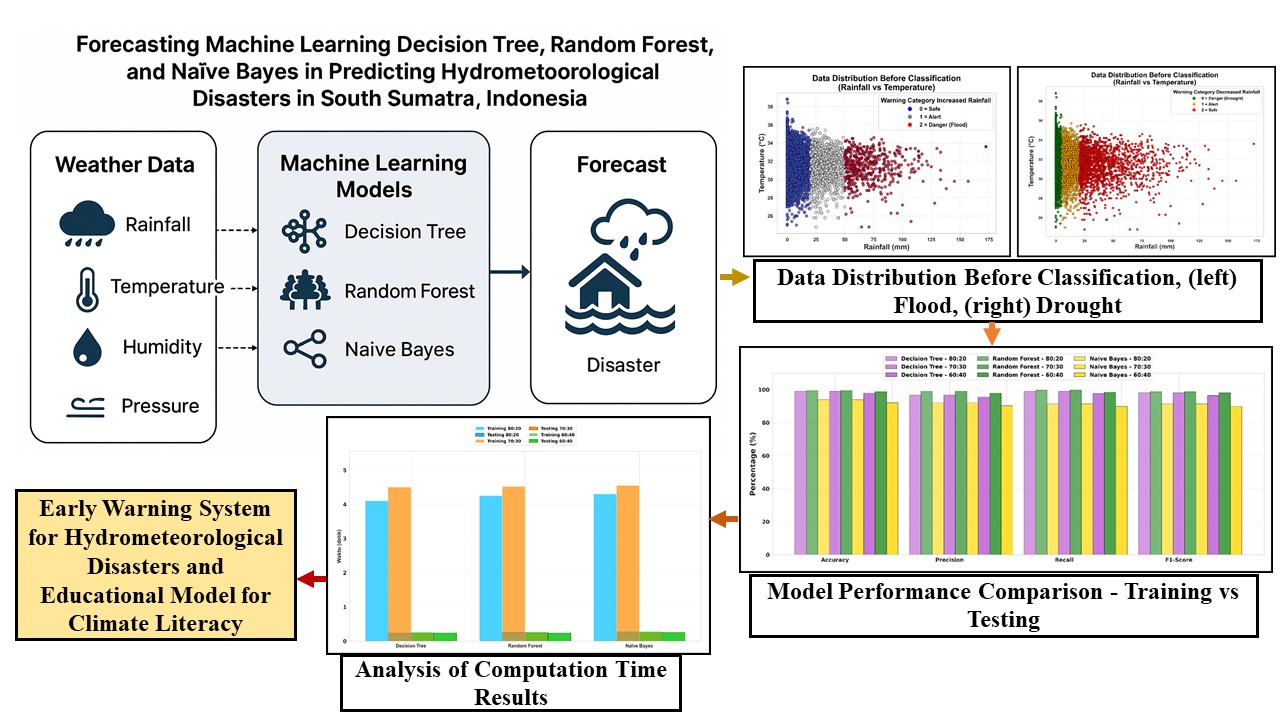
Hydrometeorological disasters that still occur in cities or areas in South Sumatra, especially along the banks of the Musi River, are floods and peatland fires that trigger haze to cover all areas of South Sumatra, especially the capital city of Palembang. The cause of flooding is generally due to the increasing volume of water in the Musi River and high rainfall intensity, while peatland fires trigger prolonged thick haze disasters. Prevention of hydrometeorological disasters is difficult to do because of the inaccuracy of data in flood and land fire predictions provided by the local government to the community. Therefore, this study was conducted as a more accurate anticipation with better performance and accuracy. This study uses a dataset obtained from the South Sumatra Climatology Station and its surroundings with parameters of river water level and rainfall intensity from 1981 to 2024. The method used to detect the occurrence of hydrometeorological disasters, especially floods and droughts, is the decision tree, random forest, and Naïve Bayes machine learning algorithms. The experimental results show that the method with the best performance is Random Forest compared to other methods, with an average value of accuracy, precision, recall, and F1-score of 99.05%, 97.91%, 99.18%, and 98%, respectively, and an average computation time of 0.2561 seconds from 3 tests conducted based on different data sharing ratios. The results of this study provide a significant contribution to the use of machine learning methods for more accurate prediction of hydrometeorological disasters in the South Sumatra region. These findings are expected to support disaster risk mitigation efforts through a more effective early warning system, as well as being a strategic reference for policymakers and related parties in data-based disaster management planning.