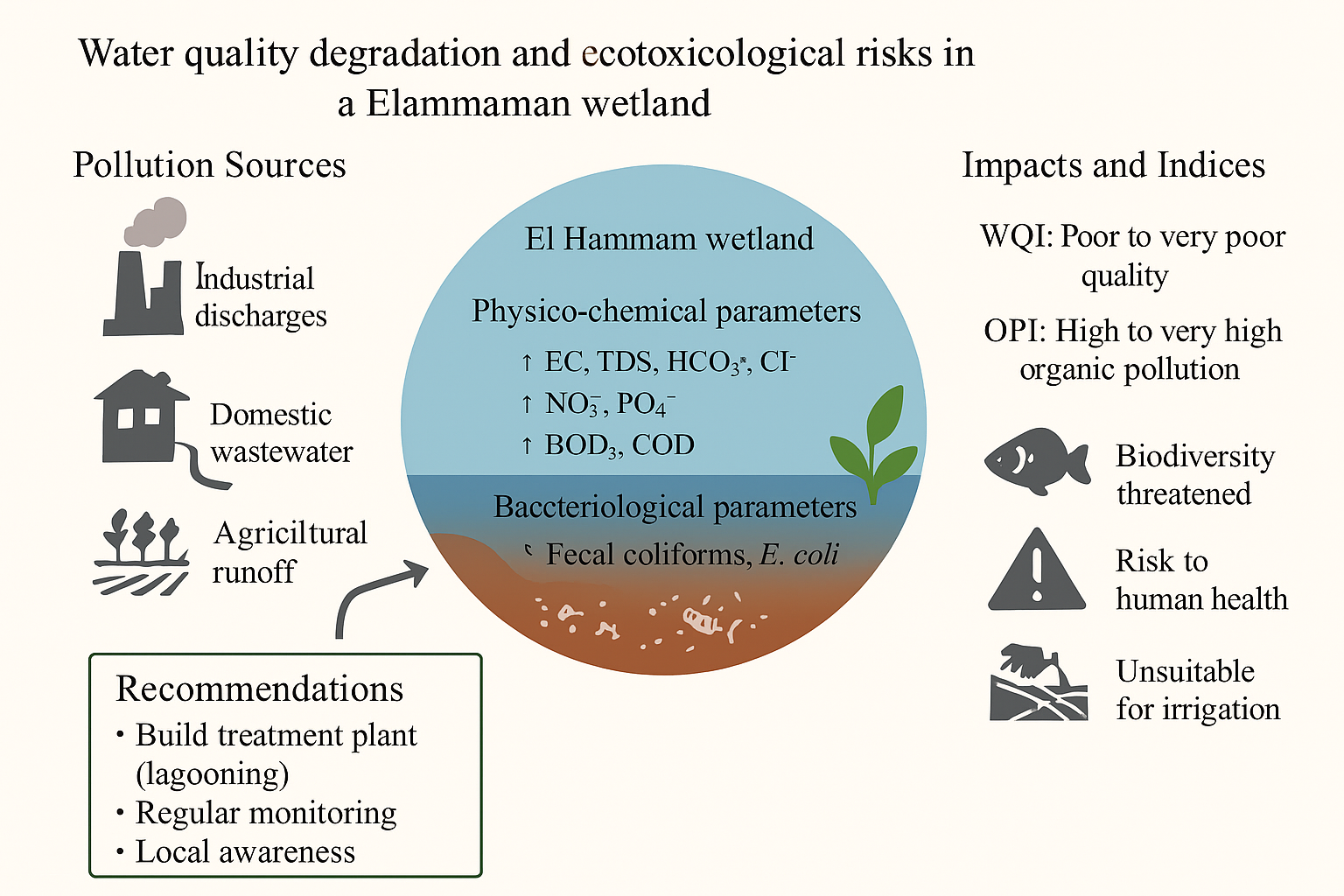
Wetlands as vital reservoirs of biodiversity and ecosystem services, are increasingly threatened by anthropogenic pressures and inadequate environmental management. Despite their ecological importance, few studies have focused on the integrated assessment of water quality and ecotoxicological risks in the Mediterranean wetlands of Algeria. This study aims to evaluate the physicochemical, bacteriological, and ecological quality of surface waters in the El-Hammam wetland (Medjana) region, Bordj Bou Arreridj, Eastern Algeria. A comprehensive set of parameters including temperature, pH, electrical conductivity, dissolved oxygen, BOD₅, nutrients ((HCO₃⁻) levels ranged from 353 mg/L to 475.8 mg/L , (Cl⁻) concentrations were also elevated, varying between 497 mg/L and 798 mg/L ,(NH₄⁺) concentrations ranged from 0.64 mg/L to 2.86 mg/L and Nitrate (NO₃⁻) concentrations ranged from 10.54 mg/L to 35 mg/L with (NO₂⁻) values were relatively low, ranging from 0.02 mg/L to 0.41 mg/L), and microbiological indicators (total and fecal coliforms, fecal streptococci, mesophilic flora) was analyzed across multiple sampling sites. The Pearson correlation matrix was used to identify significant relationships among the physicochemical variables and to determine the primary pollution sources. The results reveal substantial degradation of water quality, primarily driven by urban, agricultural, and industrial discharges, as well as climatic and edaphic factors. BOD₅ values exceeded 10 mg/L in several sites, and nitrate concentrations reached up to 40 mg/L, indicating organic and agricultural contamination. Faecal coliforms exceeded 2000 CFU/100 mL, highlighting serious sanitary and ecological risks. The Organic Pollution Index (IPO) and other quality indicators confirmed an alarming ecological imbalance, threatening both biodiversity and human health. Overall, this study provides a comprehensive diagnosis of surface water degradation in a semi-arid region north of Africa.