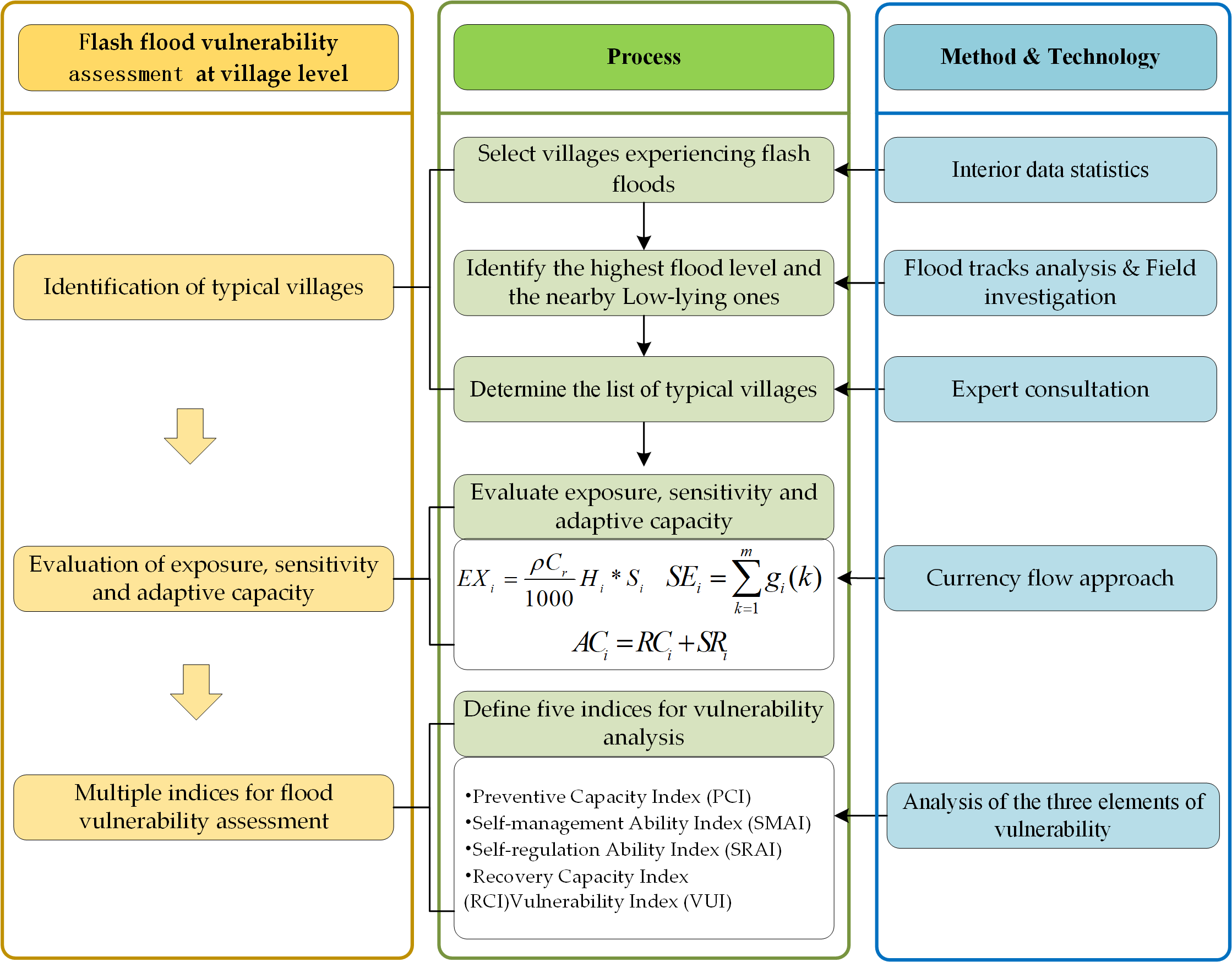
In recent years, flash floods have caused significant losses in most areas of the world. However, the assessment of flash flood vulnerability is lacking and weak, especially for the rural areas at village level in China. This work introduces a novel currency flow approach to analyze the flash flood vulnerability for typical villages of Baoting County in Hainan province, China. The typical villages are selected and identified by expert consultation and field investigation of flood events. The three elements of flood vulnerability like exposure, sensitivity and adaptive capacity are measured in monetary form with a currency flow approach. The multiple indices are developed to analyze flash flood vulnerability in terms of the relationships of the three elements. Results show that most identified typical villages of Baoting County have the relatively large values of Vulnerability Index (VUI). The numerical results in the study area for VUI, SMAI, SRAI and PCI fall within the ranges of 0.86-8.58, 1.6-21.79, 0.13-1.76, 0.008-0.26 and 0.11-1.26. It is essential to increase the investment in engineering and non-engineering measures especially in villages of Sidui (SD), Yidui(YD) and Shenjin(SJ), for more resilient to the effects of flash floods. The NSE result of the standardized numerical value of transferred population in the historical process of flash flood disasters and the standardized numerical value of flash flood vulnerability assessment ranking results is is 0.747, indicating that the accuracy of the currency flow approach is high. The currency flow approach proposed in this work reveals the relationships between exposure, sensitivity and adaptive capacity, identifying village and element of vulnerability that need strengthened against flash flood. The work findings will have a promising application prospect in flash flood management.