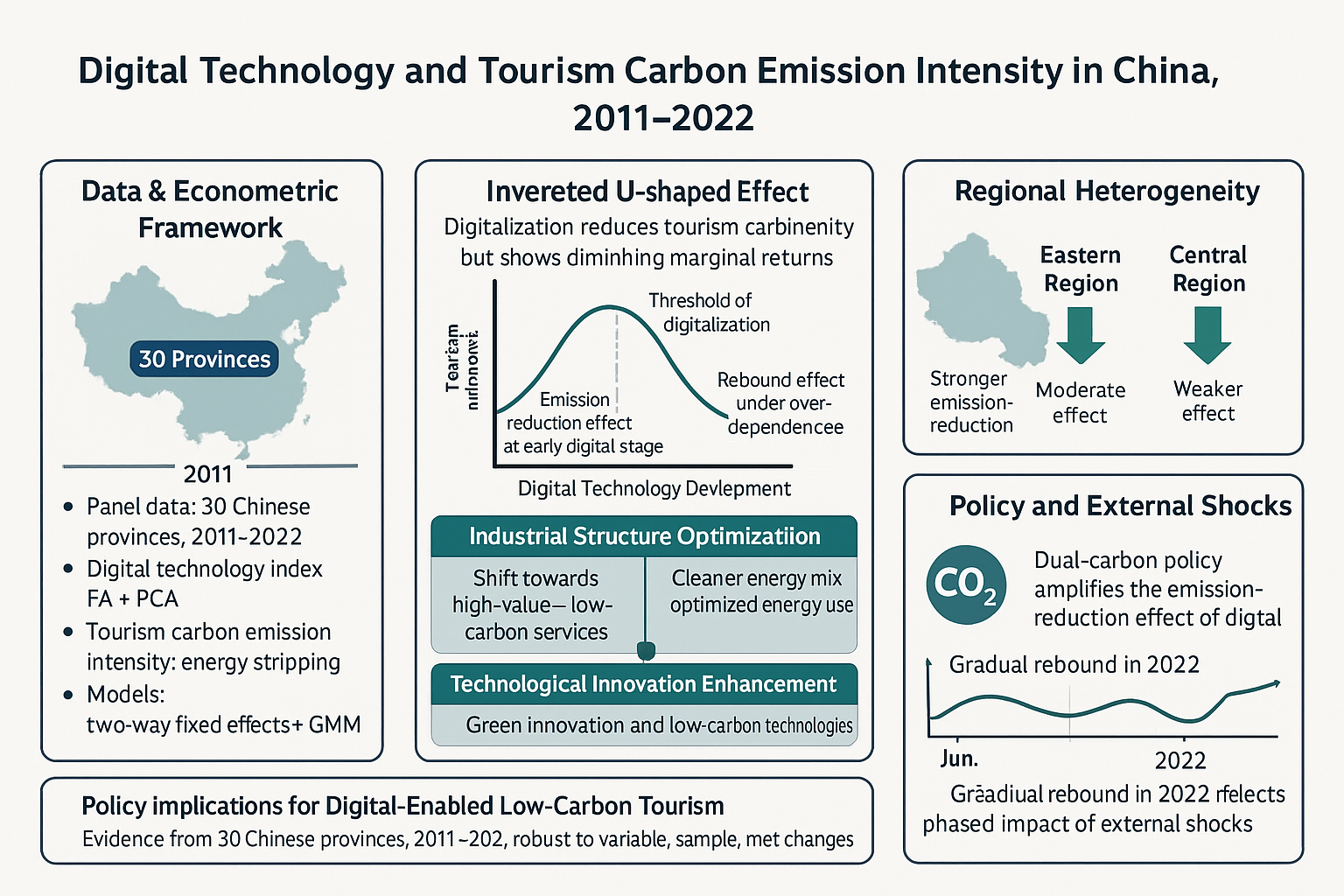
Under China’s “dual-carbon” targets, the tourism industry’s green transformation increasingly depends on deep integration of digital technology. Using panel data from 30 Chinese provinces (2011–2022), this study constructs a tourism carbon emission intensity dataset with an energy-stripping method and develops a multidimensional digital technology index via factor analysis. Two-way fixed-effects and system GMM models are employed to estimate the impact of digital technology on tourism carbon intensity, while nonlinear specifications test for turning-point effects. Regional heterogeneity is examined through cluster-based quantile regressions, and a structural equation model verifies three transmission mechanisms: industrial structure upgrading, energy-efficiency improvement, and innovation enhancement. Multiple robustness checks (lagged regressions, placebo tests, Monte Carlo simulation, counterfactual analysis) confirm result reliability. The findings show that digital technology significantly reduces tourism carbon emission intensity and exhibits an inverted U-shaped relationship, with a strengthened decarbonization effect after China’s “dual-carbon” policy. All three mediating channels are significant, and the effects vary across regional development levels and carbon-intensity quantiles. Provides sector-specific evidence of digital-driven decarbonization and offers policy implications for promoting smart, low-carbon tourism in developing economies.
Keywords: digital technology; tourism industry; carbon emission intensity; nonlinear relationship; mediating mechanisms