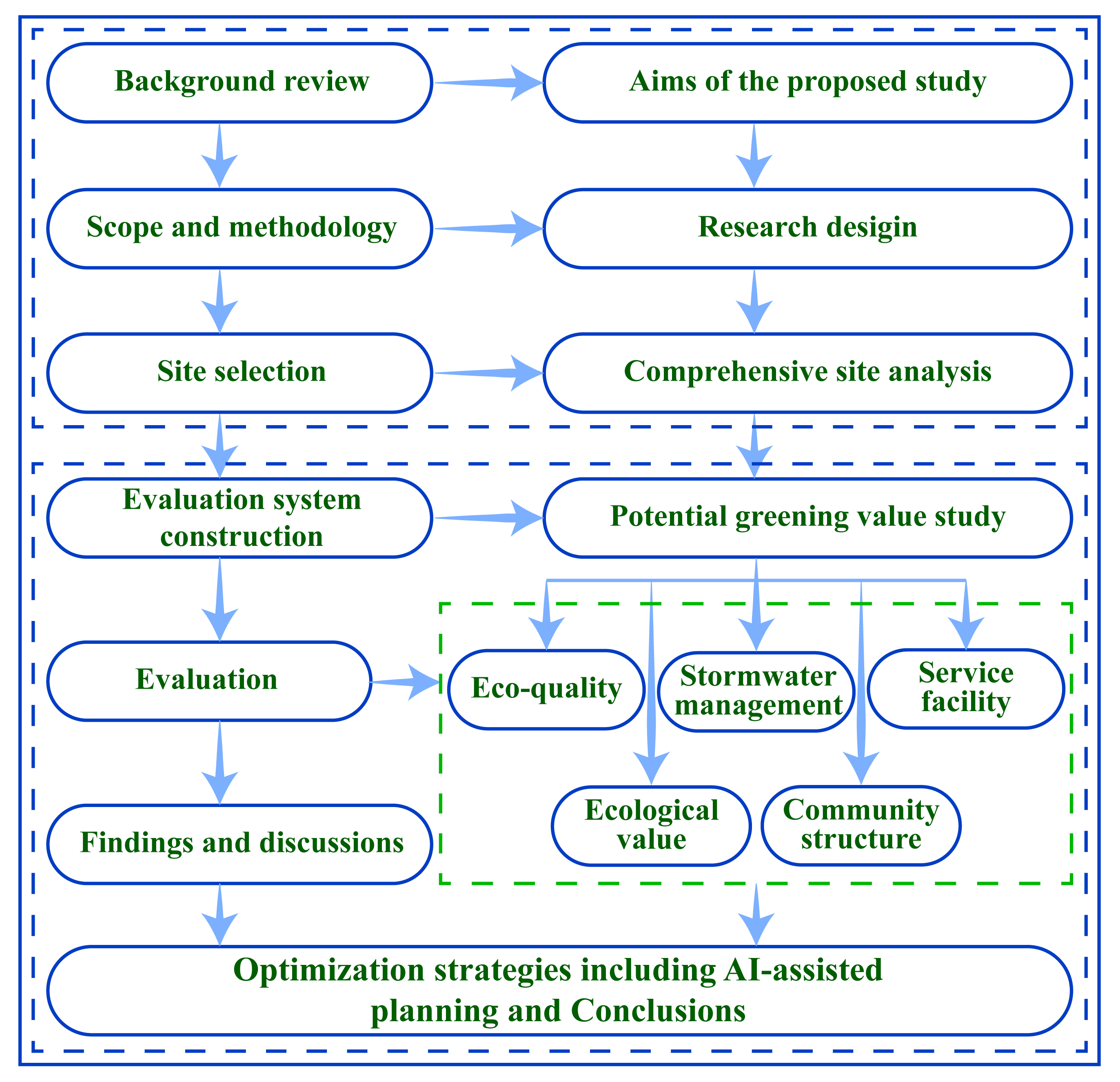
With the upgrading of urban industrial structures, the regenerative use of industrial wasteland has become vital for sustainable urban renewal. Transforming such sites into green spaces can alleviate urban green space shortages and improve ecological quality. This study focuses on two distinct industrial wasteland sites in Harbin’s Xiangfang District, namely the former Xingguang Machinery Factory (XMF) and the former Textile Printing and Dyeing Factory (TPDF). A green value evaluation system comprising five criterion layers and 21 indicators was established using the Analytic Hierarchy Process (AHP), and field surveys and GIS analysis were applied for assessment. The results indicate that XMF (score 3.76) exhibits significantly higher green value than TPDF (score 2.44), mainly due to differences in ecological quality, pollution levels, and urban integration. Differentiated regeneration strategies incorporating AI-assisted planning (e.g., machine learning for contamination mapping and generative design for spatial configuration) are proposed. For XMF, an ecology-culture integrated park is recommended, while for TPDF, an art-led green cultural-creative district with zoned remediation is suggested. This research offers a scientifically supported and technology-informed approach for the sustainable regeneration of industrial wasteland.
Keywords: industrial brownfield, green value evaluation, analytic hierarchy process (AHP); landscape optimization strategy, Harbin