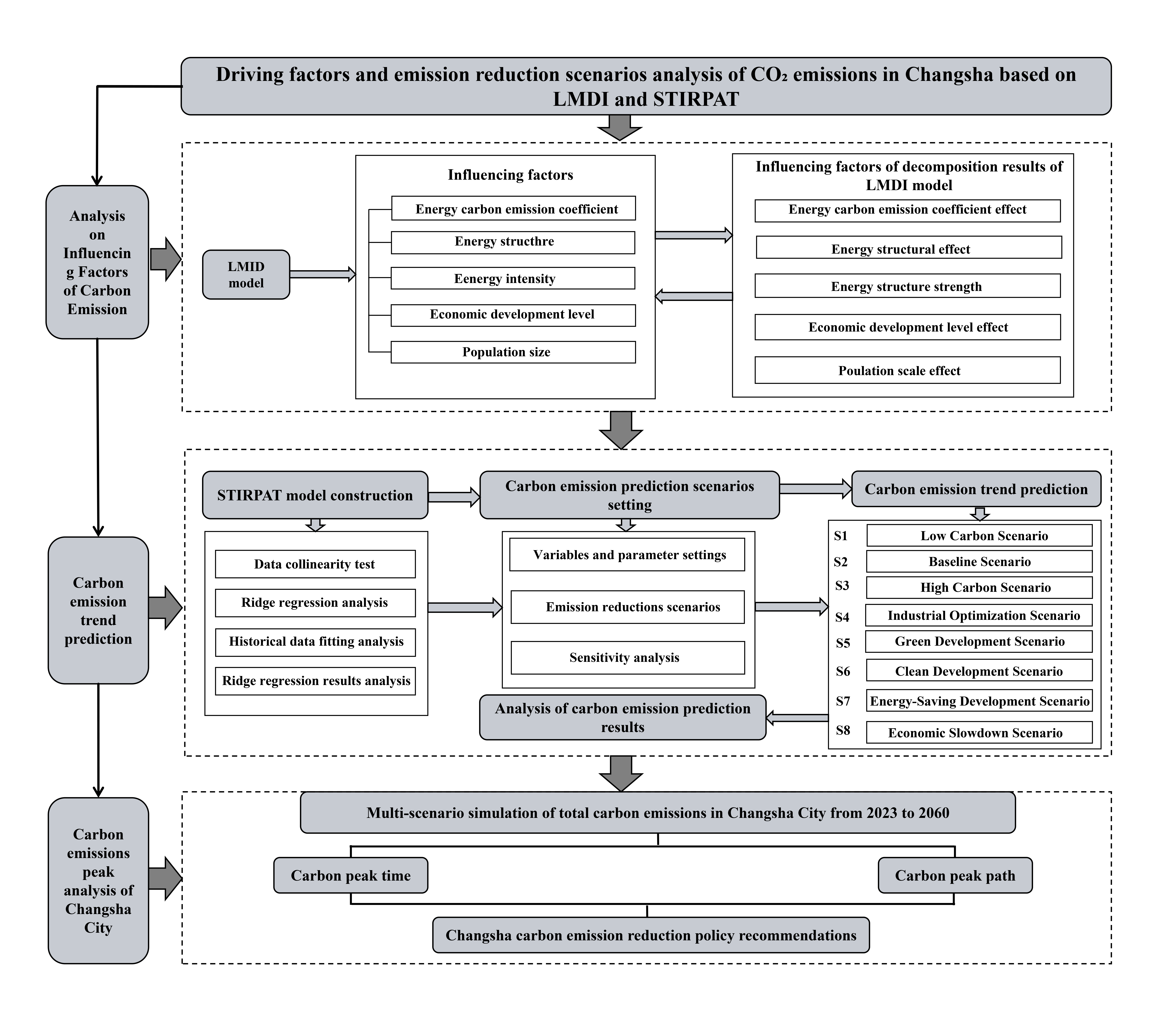
As the central city of Hunan Province, Changsha is a key to grasping how carbon emission growth is playing out and getting the peak carbon emission event to happen faster than initially planned. In this study, it adopts the data from 2011 to 2022 to build the LMDI-STIRPAT model and forecast the carbon emission trend of Changsha. Through scenario simulations, the research identifies the primary factors influencing carbon emissions, projects future emission trajectories, and determines the optimal pathways for emission reduction. The main results: (1) The energy structure restrains the growth of carbon emission, while the population size is still a big pusher that helps increase the carbon emission. (2) Out of eight forecasting situations, only situation S1 arrives at the carbon peak goal by 2030, which achieves 20.37 Mt, whereas the others vary in their delay. (3) Changsha reaches its carbon peak according to the plan in the low-carbon situation S1, making it the most effective option for emission cuts. To achieve this, the paper gives recommendations such as modifying energy consumption structure, optimizing industrial layout, and reinforcing related the policy framework supporting cities low carbon transition and explained in conclusion.