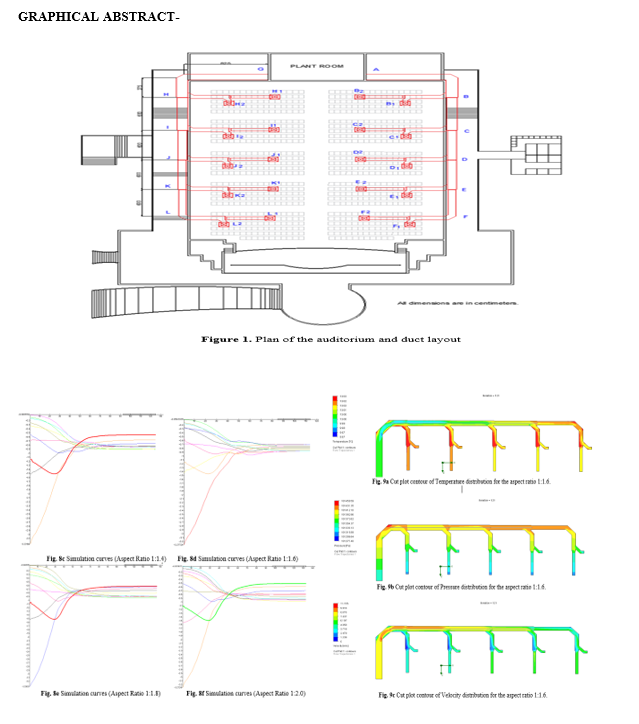
Heating, Ventilation, and Air Conditioning (HVAC) systems play a vital role in maintaining indoor environmental quality, occupant health, and thermal comfort in large public spaces such as auditoriums. However, inadequately designed duct networks often result in uneven airflow, increased energy consumption, and higher operational costs, thereby contributing to greater environmental impact. In this study, cooling load calculations were performed based on occupancy and seating arrangements, followed by diffuser placement and duct network design. Duct sizing was carried out using the Equal Friction Method, and pressure variations across ducts with different aspect ratios were numerically analysed. Three-dimensional models of the duct system were developed using SolidWorks, and Computational Fluid Dynamics (CFD) simulations using Wizard software were conducted to evaluate airflow distribution, velocity profiles, and pressure characteristics. The results show that duct sizing optimized through the Equal Friction Method produces uniform air distribution without the need for additional flow-regulating devices, thereby reducing pressure losses and improving energy efficiency. This leads to enhanced HVAC system performance and improved indoor air quality. This study uniquely integrates the Equal Friction Method with CFD analysis by using the analytical method for initial duct sizing and the CFD model to validate and optimize airflow distribution and thermal comfort within the auditorium. This combined approach advances existing HVAC design practices by providing a more accurate, cost-effective, and performance-oriented framework compared to other methods, while also supporting sustainable and environmentally responsible building design.