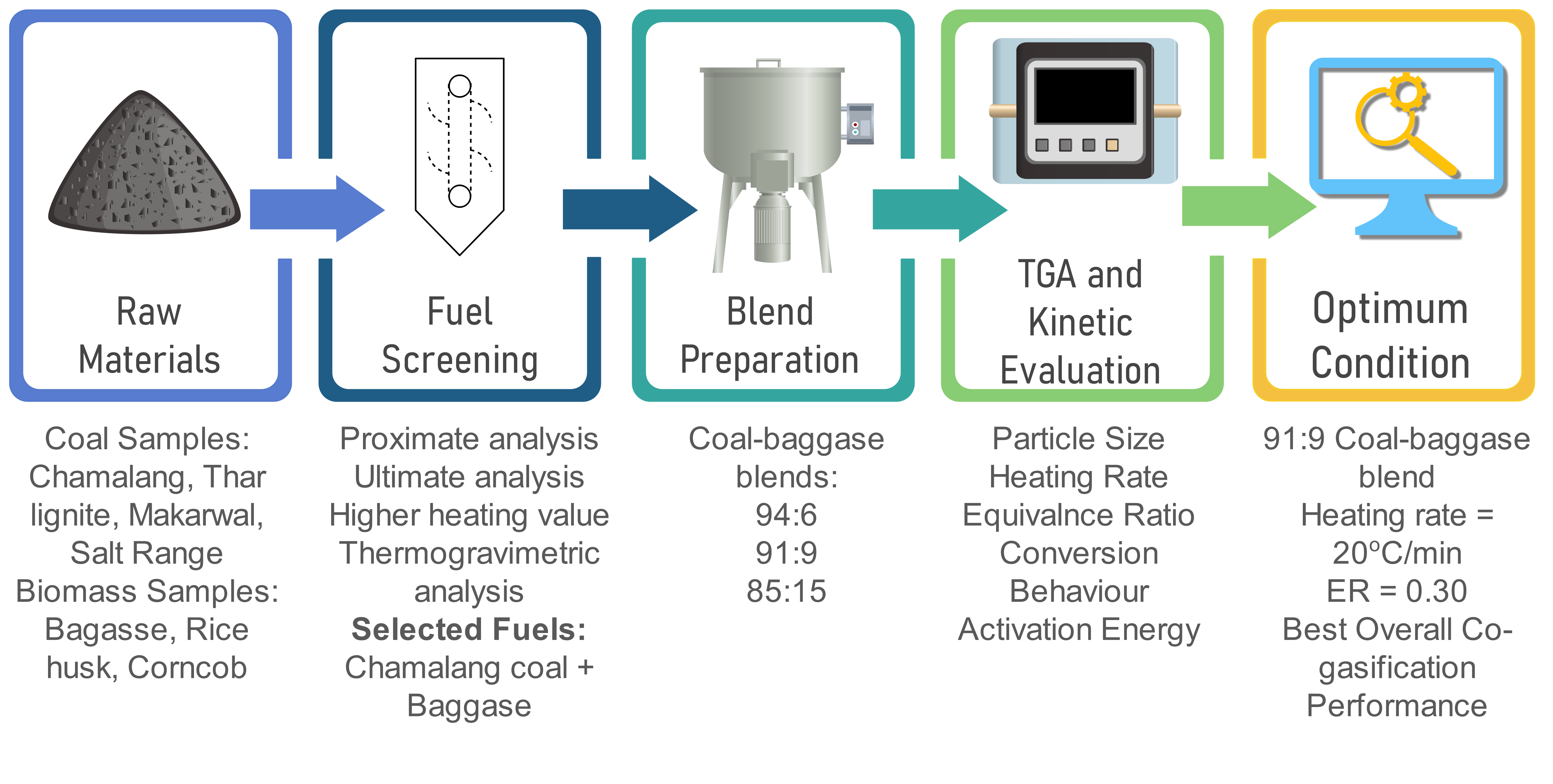
This study evaluates the co-gasification suitability of coal–bagasse blends through thermogravimetric analysis under non-isothermal conditions. Indigenous coal and biomass samples were first characterized using proximate analysis, ultimate analysis, and higher heating value determination, after which Chamalang coal and bagasse were selected for blend preparation. Coal–bagasse blends of 94:6, 91:9, and 85:15 were examined to determine the effects of operating conditions, including heating rate, feed composition, and equivalence ratio, on thermal conversion behavior and kinetic characteristics. Thermogravimetric experiments were conducted from ambient temperature to 950 °C. The thermograms showed clear differences in the conversion behavior of coal, biomass, and blended fuels, confirming the strong influence of volatile matter, fixed carbon, ash content, and inherent oxygen on reactivity. Among the tested blends, the 91:9 coal–bagasse blend exhibited the most favorable overall performance. The highest overall conversion was obtained at an equivalence ratio of 0.30 and a heating rate of 20 °C min⁻¹. Kinetic analysis further supported this result, with activation energies for the 91:9 blend reported as 26.75, 26.54, and 25.64 kJ mol⁻¹ at ER values of 0.25, 0.30, and 0.35, respectively. These findings demonstrate the potential of optimized coal–bagasse blends for efficient co-gasification system design.