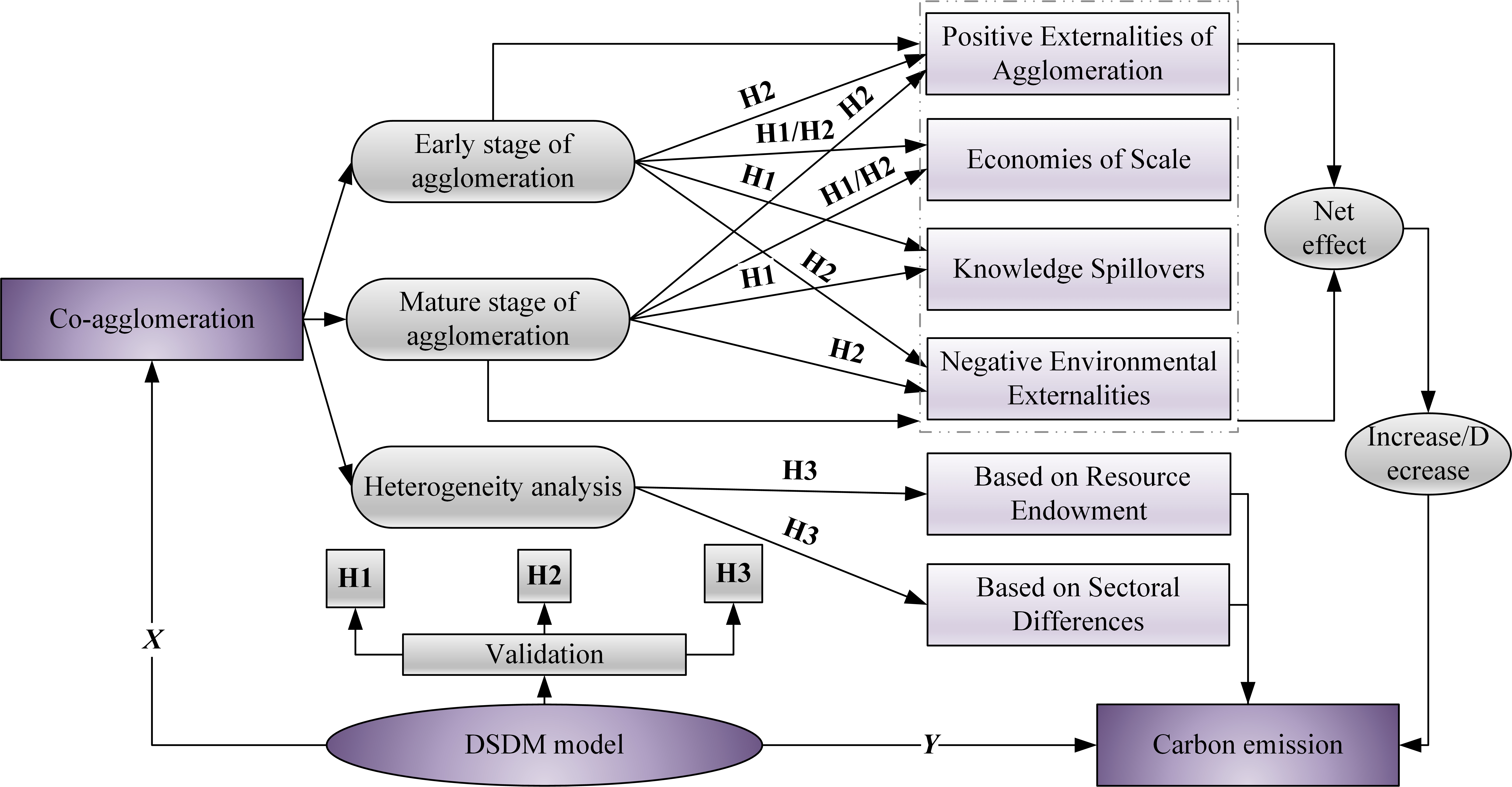
Under the dual carbon goals, the mechanism through which regional industrial co-agglomeration affects carbon emissions remains insufficiently understood. Taking Northeast China as a case study, this study employs a dynamic Spatial Durbin Model (SDM) to analyze the impact relationship and the underlying mechanisms through which the co-agglomeration of producer services and manufacturing influences carbon emission intensity. The findings showed that: (1) A pronounced spatial polarization of industrial co-agglomeration levels exists in Northeast China, with carbon emission intensity exhibiting strong spatiotemporal dependence. (2) The co-agglomeration of producer services and the manufacturing sector demonstrates to have a significant inverted U-shaped relationship with carbon emission intensity. This mechanism stems from the interaction between economies of scale and externalities. (3) The heterogeneity analysis indicated that the impact of industrial co-agglomeration on carbon intensity was more significant in non-resource-based cities, and exhibited substantial variation across different sectors. The co-agglomeration of the financial and manufacturing sectors is more likely to cross the inflection point of the inverted U-curve.