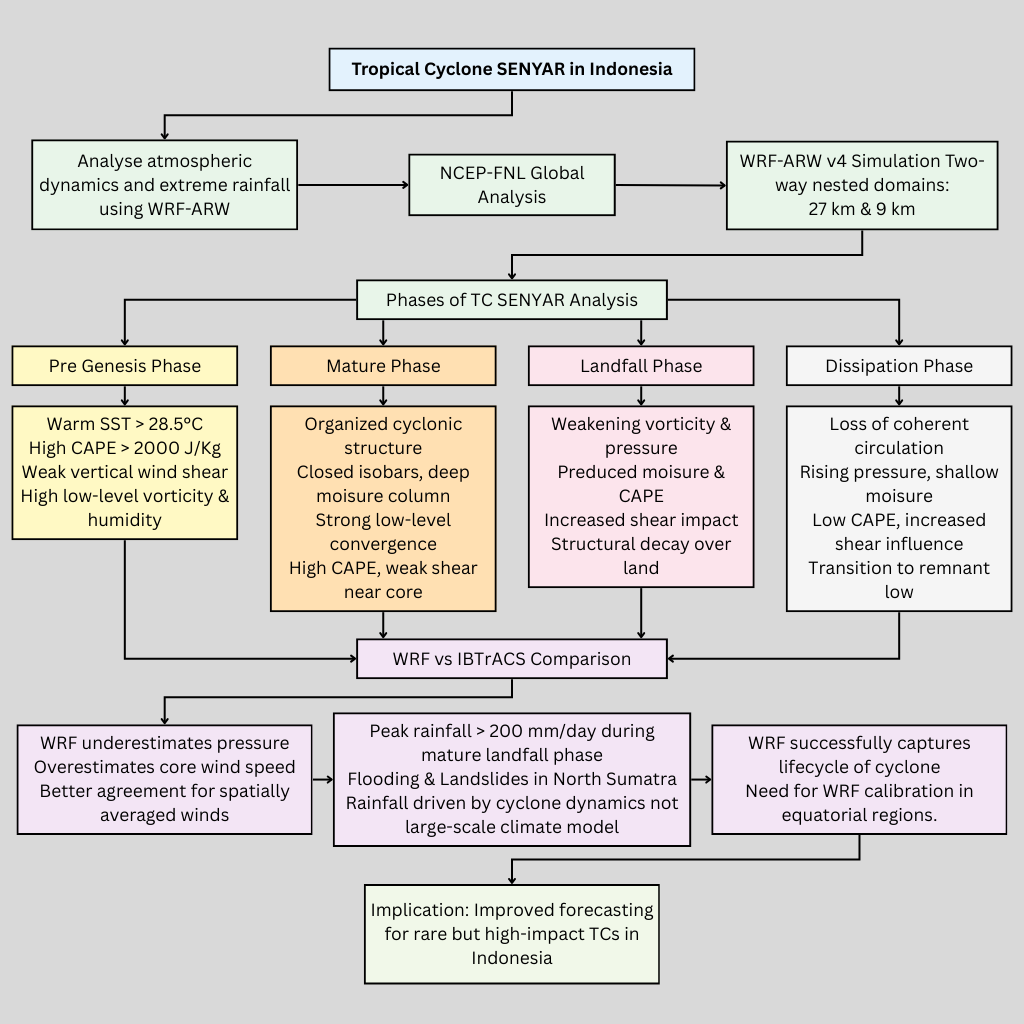
Tropical Cyclone SENYAR is a rare landfalling tropical cyclone event in the Indonesian region, where tropical cyclones seldom reach land. This study investigates the atmospheric evolution and intensity characteristics of SENYAR using high-resolution simulations from the Weather Research and Forecasting (WRF-ARW) model, evaluated against IBTrACS best-track data. The model employs a two-way nested configuration with horizontal resolutions of 27 km and 9 km to capture both large-scale environmental conditions and mesoscale storm structures. Results show that the pre-genesis phase is characterized by warm sea surface temperatures, increasing convective instability, low-level moisture, enhanced relative vorticity, and weak vertical wind shear, creating a favorable environment for cyclogenesis. During the mature phase, SENYAR exhibits a well-organized cyclonic structure with closed low-pressure isobars, strong low-level vorticity, deep moisture columns, and intense winds around the eye. Following landfall, moisture depletion, reduced convective energy, increased sensitivity to vertical wind shear, and weakening wind fields lead to rapid structural decay. The dissipation phase is marked by rising surface pressure and a loss of coherent circulation. Comparison with IBTrACS indicates that WRF tends to underestimate minimum sea level pressure and overestimate peak wind speeds near the cyclone core, while spatially averaged winds show better agreement. Despite intensity biases, the WRF model captures the essential mesoscale dynamics governing TC SENYAR's lifecycle.