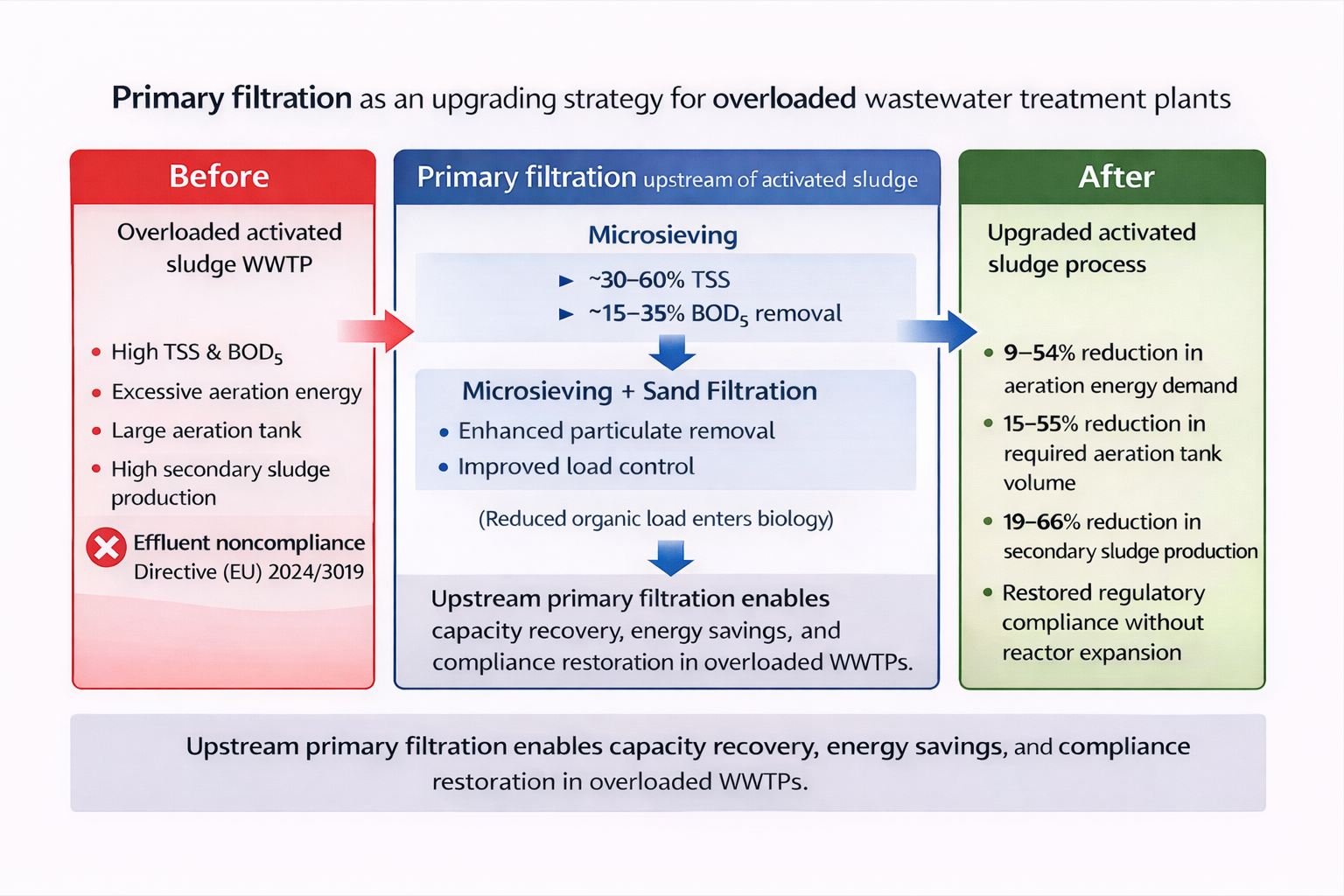
Increasing hydraulic and organic overloading has intensified upgrading pressures on municipal wastewater treatment plants (WWTPs). Rising energy costs and stricter regulatory requirements further constrain reliance on conventional biological reactor expansion strategies. This study evaluates primary filtration applied upstream of activated sludge processes using a steady-state mass and energy balance modelling approach. The assessment examines microsieving and a combined microsieving-sand filtration configuration applied to overloaded WWTPs. Two representative operational scenarios are considered in the analysis. These correspond to average influent flow rates of 10,000 and 15,000 m³/d under extended aeration conditions. A comprehensive steady-state mass and energy balance framework was applied. This framework quantifies changes in aeration tank volume, oxygen demand, aeration energy consumption, and secondary sludge production. Microsieving alone achieved aeration energy reductions ranging from 9% to 27%. The combined microsieving-sand filtration configuration enabled aeration energy reductions of up to 54%. Aeration tank volume requirements were reduced by 15-55%, depending on influent loading and filtration performance. Secondary sludge production decreased substantially, while primary sieved solids (PSS) with high dry solids content enhanced anaerobic digestion potential. For severely overloaded systems failing to comply with Directive (EU) 2024/3019, primary filtration restored effluent quality compliance without biological reactor expansion. Overall, primary filtration emerges as a space-efficient upgrading strategy aligned with European energy-neutrality objectives.