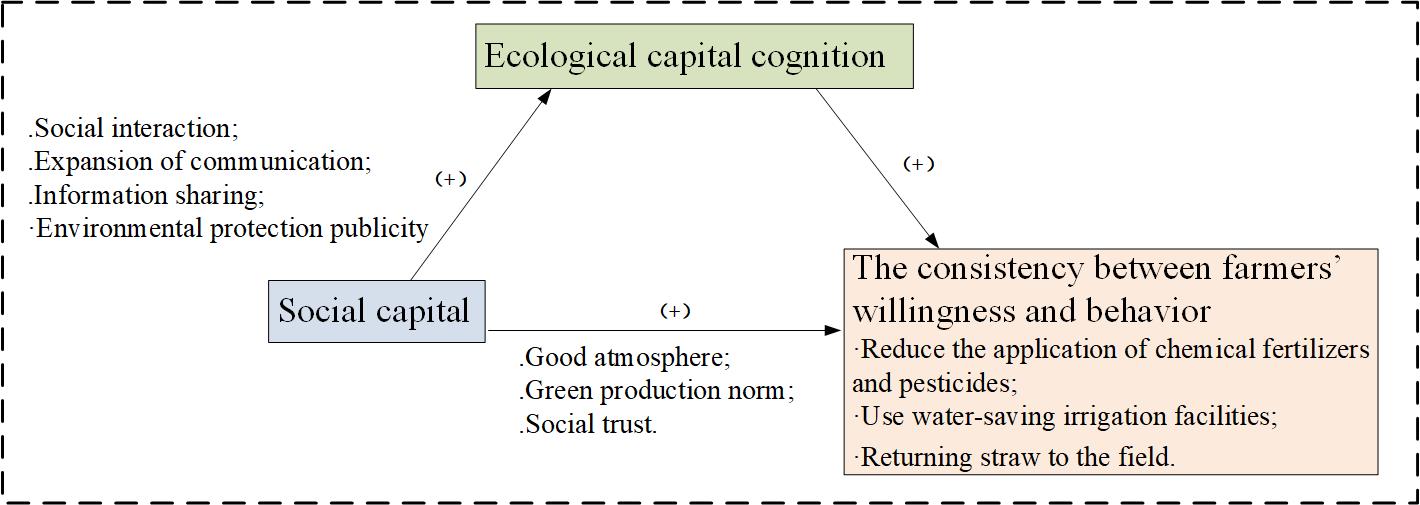
Farmers’ participation in agricultural non-point source pollution (ANPSP) control is essential for rural eco-environment and food security. Based on 1299 questionnaires from 91 counties in 16 prefecture-level cities / autonomous prefectures in Yunnan Province, China, this paper empirically investigates and explores the effect of social capital on farmers’ willingness, behavior, and consistency to reduce ANPSP. This study’s findings indicate that most of respondents are willing to take or have taken actions to reduce ANPSP. However, the average proportion of willingness and behavior is 89.71% and 74.42%, indicating a high inconsistency between willingness and behavior. Social capital exerts a significantly positive influence on farmers’ willingness, behavior, and consistency. Additionally, ecological capital cognition is introduced as an intermediary variable, and shows an important role in the impact of social capital on farmers’ behavior and consistency. Furthermore, heterogeneous impacts of social capital in different regions and ethnic groups are explored, and show that social capital has more significant effects on consistency among Han farmers or farmers living in autonomous areas and large cities than that among other groups. This paper can provide references for the government to transform farmers' willingness into actual behavior and narrow the gap in the control of ANPSP.