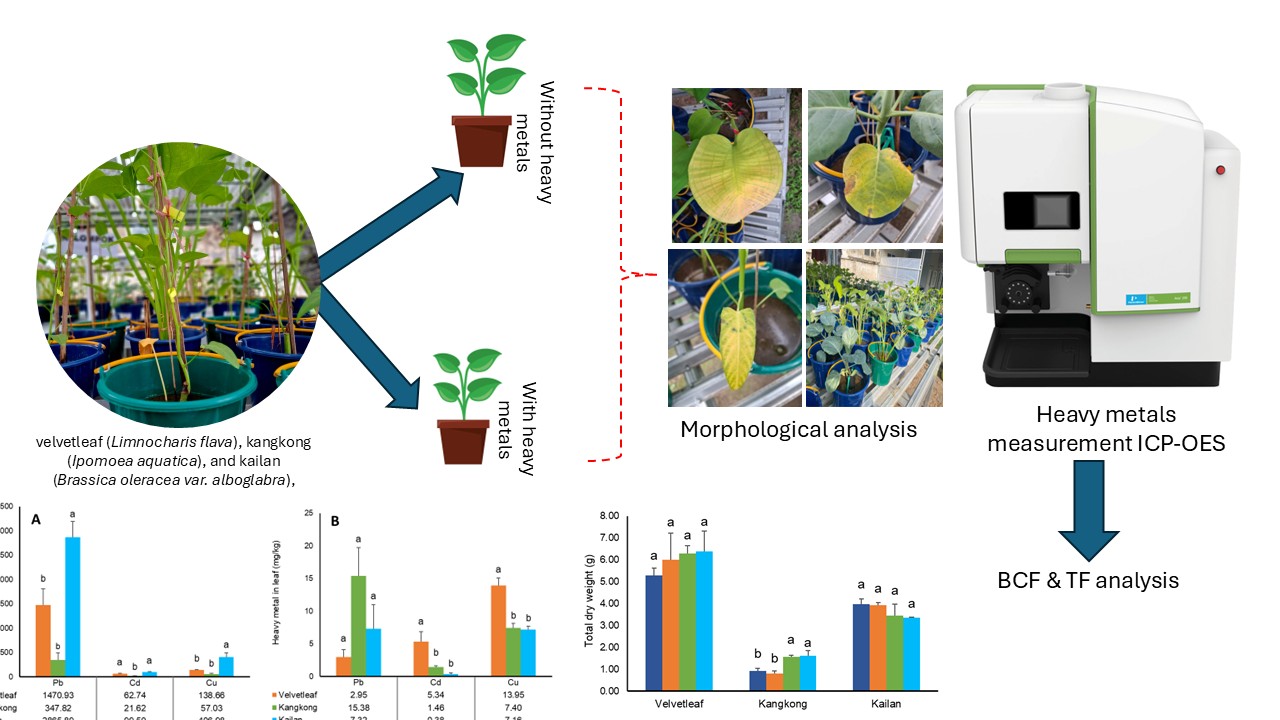
Heavy metal contamination in irrigation water poses serious risks to crop productivity and food safety, particularly for leafy vegetables that readily accumulate toxic elements. This study evaluated the growth response, bioaccumulation behavior, and health risks of three commonly consumed leafy vegetables, velvetleaf (Limnocharis flava), kailan (Brassica oleracea var. alboglabra), and kangkong (Ipomoea aquatica), exposed to Pb at 50 mg L⁻¹, Cd at 1 mg L⁻¹, and Cu at 2 mg L⁻¹ under controlled irrigation conditions. Plant length, leaf number, and leaf area were monitored over an eighteen-day exposure period. Heavy metal concentrations in roots and leaves were quantified using ICP-OES with high analytical accuracy. Data were analyzed using analysis of variance, and means compared using the Duncan Multiple Range Test (DMRT). The results showed specific growth responses for each cultivar. Kailan exhibited the strongest stress symptoms, including a twenty-four percent reduction in plant length and a thirty-three percent decrease in leaf area under Cu exposure, while velvetleaf and kangkong showed comparatively higher tolerance. Bioconcentration factors exceeded one for all metals, indicating strong accumulation potential, particularly in kailan with Pb at 2873.21, Cd at 99.87, and Cu at 414.13. Translocation factors were consistently below one, indicating restricted metal movement from roots to leaves. Despite low translocation, Pb and Cd concentrations in edible tissues exceeded FAO and WHO safety limits, resulting in very high Hazard Index values, especially for kailan at 3097.6. These findings demonstrate that plant tolerance alone does not guarantee food safety. The integration of accurate analytical measurement, mathematical performance evaluation, and health risk assessment provides a robust framework for identifying safer crop choices and guiding irrigation management in heavy metal-contaminated environments.