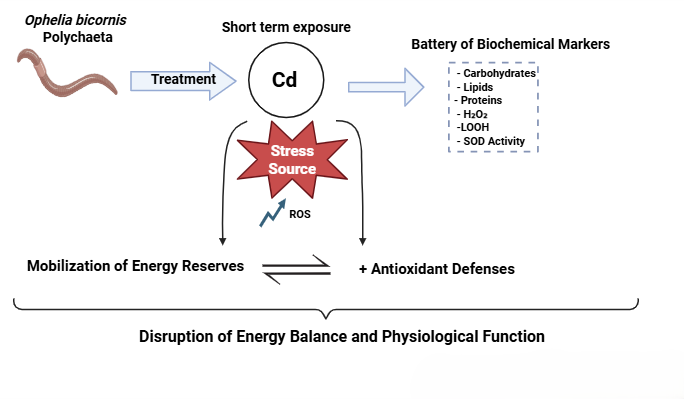
Ophelia bicornis (Polychaeta: Opheliidae) has been identified as a potential bioindicator for ecotoxicological studies. This study evaluates the short-term physiological and biochemical effects of cadmium (Cd) exposure on O. bicornis by examining energy reserves (lipids, carbohydrates, proteins) and oxidative stress biomarkers (hydrogen peroxide, lipid peroxide (LOOH), and Superoxide dismutase (SOD). Cd treatment was conducted at a sublethal concentration LC10-48h (31.11 mg/L) as previously determined. Statistical analyses revealed significant interactions between Cd treatment and exposure time affecting several biochemical parameters. Amounts of Carbohydrates increased notably after 48h in Cd-exposed individuals, indicating a time-dependent energy mobilization. Lipid contents were also affected by treatment and exposure duration, reflecting energy reserve use under metal stress. In contrast, protein remained stable, with no significant variation across treatment or time. Oxidative stress biomarkers were markedly influenced by Cd exposure. LOOH levels increased significantly with treatment and time, peaking at 48h. Similarly, H2O2 increased with Cd and exhibited a significant time-dependent interaction, highlighting a progressive oxidative challenge. SOD activity was primarily modulated by exposure duration, reaching its maximum at 48h. Overall, the present experiment shows that sublethal Cd disrupts energy metabolism and triggers oxidative stress response in O. bicornis.