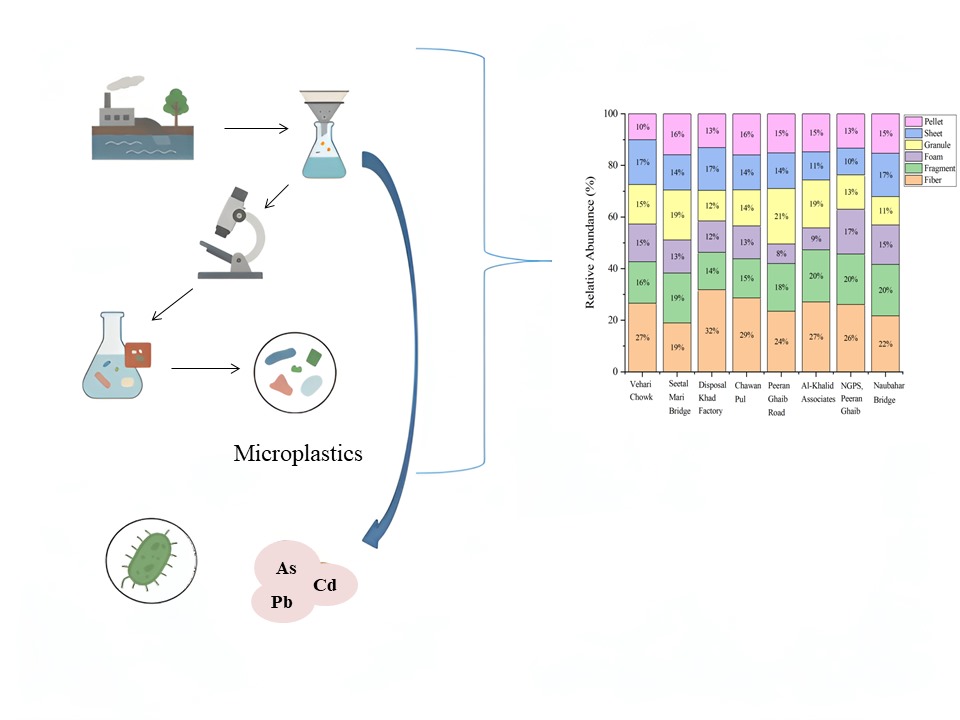
Microplastics (MPs) are ubiquitous primarily in aquatic environment where they travel freely from one place to another. Higher surface area with strong hydrophobicity made them a perfect candidate to sorb different pollutants in aquatic ecosystem. This study investigates occurrence and distribution of MPs in Qasimpur canal running in Multan city and carry large quantity of sewage waste and industrial effluents. Results describe that MPs concentration is between 25 and 6 MPs L-1. Relative distribution of MPs shows that fibers (32.01%) were prevalent in water sample followed by fragment (20.39%) while sheet and pellet were least among water samples. Weight distribution of MPs types also exhibit that fibers were dominated in water. MPs were also distributed on the basis of color where blue and white is dominant colors among all. It was attributed that possible intrusion of MPs in water is through sewage sludge and industrial effluents. Among heavy metals arsenic, cadmium and lead were detected in water. Concentration of HMs is high enough to make water hazardous as given in heavy metal pollution index (HPI). HMs was added into water through industrial effluents but MPs act as vector in transporting them in flowing water. Similarly total coliform and E.coli were detected in high concentration making negative relationship with water ecosystem. Findings from current work provide insight in accumulation, distribution and abundance of microplastics with in flowing water. Synergistic effect of MPs and HMs poses greater risk to aquatic ecosystem and organisms.