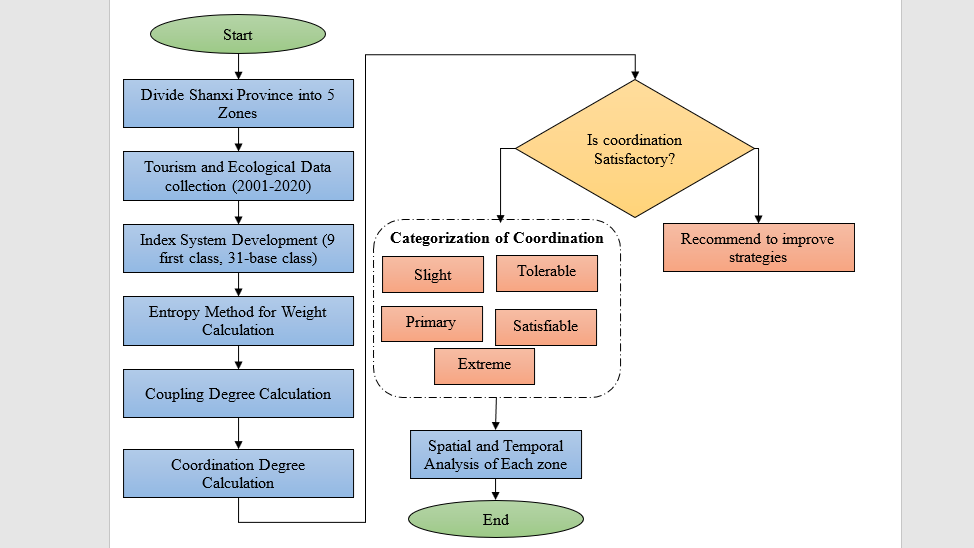
Achieving sustainable tourism is the pivotal motto of countries that have tourist revenue as an integral part of its economy. Analysis based on the spatial distribution of tourist elements is a primary factor to accomplish the sustainable development of tourism. This work focuses on investigating the spatial structure of tourist elements of Shanxi province into five zones, which are divided geographically. A holistic evaluation system is devised that explores the relationship between regional ecological environment and tourism elements of each spatial zone through the coupling coordinated model. This framework for the model is rooted on nine first class indexes with 31 base class indices which capture the characteristics of tourism elements as well as ecological traits. The study is based on data collected for a comprehensive period of about 20 years, primarily sourced from the China Statistical Yearbook (2001–2020), China Tourism Statistical Yearbook (2001–2020), and Shanxi Statistical Yearbook (2001–2020). The results indicate that the country is slowly and marginally heading towards achieving good coupling coordination degree despite the impact of industrial activity and rapid tourism development.