Abstract
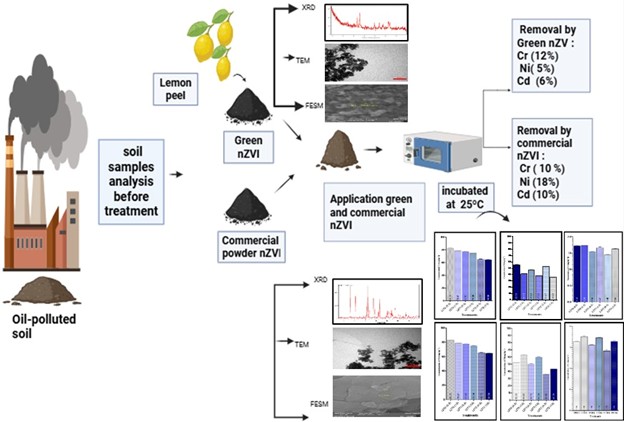
Soil contamination by heavy metals poses serious environmental risk. This study investigated soils impacted by refinery discharges from Gwer Road, Erbil, Iraq, focusing on soil physicochemical properties, baseline contamination, and nanoscale zero-valent iron remediation. Soil samples were collected from southern and northern sites at 50 m and 200 m distances and 30 cm depth. Soil texture, pH, and cation exchange capacity varied between sites, affecting heavy metal distribution. Chromium (52.85-79.54 mg.kg⁻¹), nickel (41.10-63.42 mg.kg⁻¹), and cadmium (1.41-1.76 mg.kg⁻¹) exceeded Environmental Baseline Standards (EBS), indicating refinery-derived pollution. The study evaluated the remediation potential of green-synthesized nZVI from lemon peel extract and commercial nZVI. Nanoparticle characterization using FESEM, TEM, and XRD confirmed nanoparticle size, core-shell shape, and crystallinity. Application of 0.5 g/kg soil provided 12%, 5%, and 6% removal efficiency for Cr, Ni, and Cd using green nZVI, compared to 10%, 18%, and 10% using commercial nZVI. Although green nZVI removes chromium similarly, it is sustainable, locally sourced, and cost-effective. Remediation efficacy was influenced by soil properties, baseline contamination, and nanoparticle characteristics. This study represents the first application of green and commercial nZVI for the remediation of refinery-affected soil, providing a sustainable approach for mitigating heavy metal pollution and enhancing industrial site management.