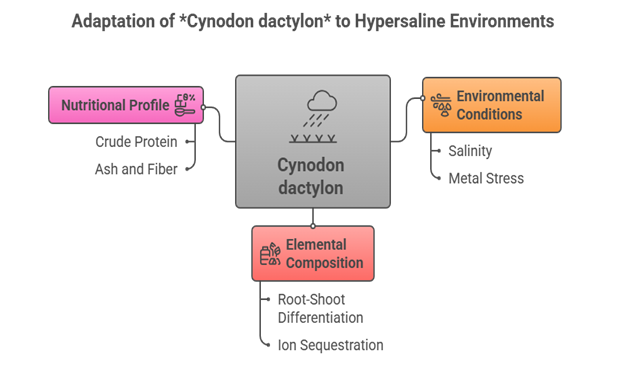
Bermuda grass (Cynodon dactylon) growing alongside lakes and springs in the Salt Range was analyzed for its elemental profile and nutritional status to investigate its adaptation to prevailing environmental conditions. This study is the first to document the response of C. dactylon in this region. We determined the concentrations of 14 elements, including nutrients (N, P, K, Ca, Na, Mg) and heavy metals (Zn, Fe, Mn, Cu, Co, Cd, Pb, Ni), as well as moisture, crude protein, crude fat, crude fiber, ash, net energy, and nitrogen-free extract. Statistical analysis using ANOVA, Tukey's HSD, and canonical correspondence analysis (CCA) revealed significant variations in elemental content and proximate composition. Water and soil analysis showed that the study sites ranged from saline to hypersaline, with Cr exceeding FAO limits at all sites. The elemental concentrations in roots and shoots followed distinct patterns, with Mn>Ca>Fe>Na>Pb>Mg>Zn>Cu>Co>Ni>N>K>Cd>P in roots and Fe>Cu>Zn>Mn>Mg>Na>P=Pb>Ni>Co>Cd>K>Ca>N in shoots. Notably, Cu and Zn had their highest values at the Khewra Mine, likely due to drainage water deposition in the soil. The highest moisture content was found at Khabeki Lake (90.83%), while crude protein (14.21%), crude fat (3.21%), crude fiber (27.533%), and ash (8.21%) content varied across sites. Our findings indicate that Bermuda grass has acclimatized to the prevailing conditions and can thrive in hypersaline environments, making it a potential fodder grass for grazing animals.