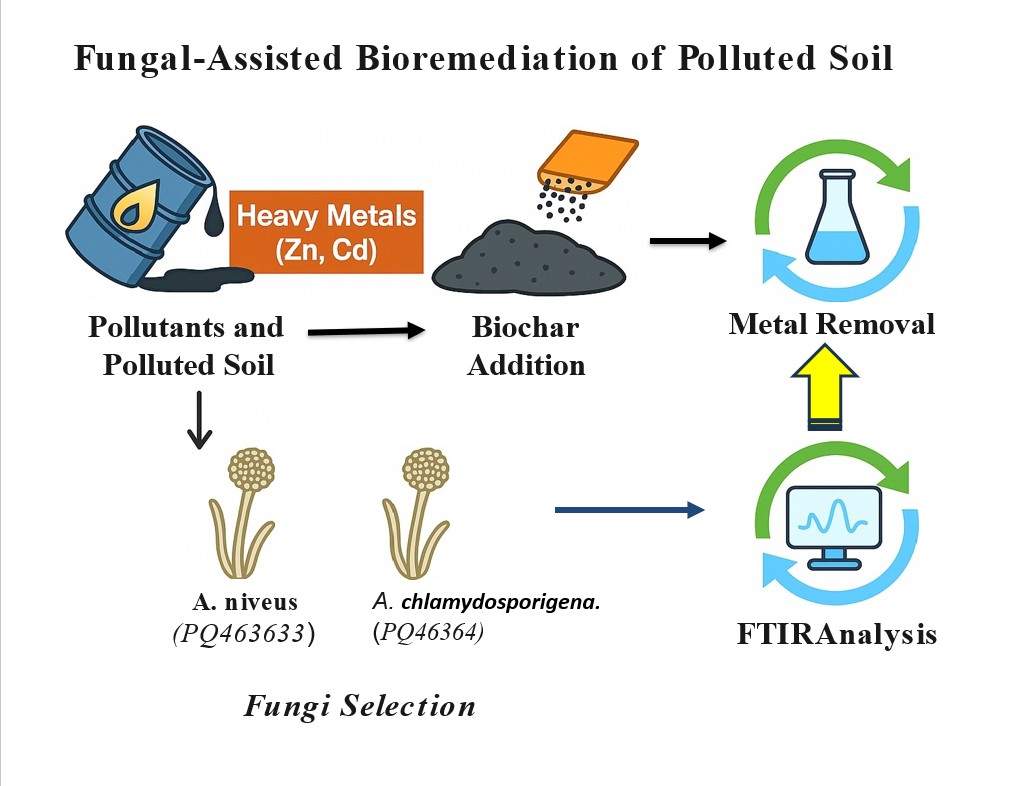
Bioremediation of oil contaminated sites common in oil-producing regions needs novel solutions such as suggested here: combining fungal and biochar treatments. Fungal strains were isolated from metal and oil polluted soils and evaluated for their resistance to zinc (Zn) and cadmium (Cd). Two strains, Aspergillus niveus (GenBank accession: PQ463633) and Alternaria chlamydosporigena (PQ463634), exhibited exceptional growth under metal stress, demonstrating considerable metal resistance. These strains were chosen for further bioremediation experiments. A substantial decrease of Zn and Cd concentrations were observed after fungal incubation. The incorporation of biochar significantly improved the effectiveness of the heavy metal removal, indicating a synergistic interaction between fungal biosorption and biochar-facilitated immobilization. Fourier-transform infrared (FTIR) spectroscopy demonstrated notable morphological and biochemical changes in the fungal biomass following exposure to Zn and Cd, signifying active metal-binding interactions and uptake processes. The equilibrium behavior of metal uptake was demonstrated with three isotherm models. The Langmuir model showed the greatest fit (R² > 0.98), followed by the Freundlich model (R² = 0.92-0.95) and the Temkin model (R² = 0.85-0.89). A homogenous, monolayer-driven biosorption of the metals is supported by the best fit of the Langmuir isotherm. Kinetic models were utilized to examine the rate and mechanism of the biosorption process. A high correlation coefficient (R² = 0.98) for the pseudo-second-order model suggests that chemisorption is the primary mechanism for the uptake of Zn and Cd by biochar and fungi. It is concluded that the combination of biochar and the fungi A. niveus and A. chlamydosporigena offer an economical and environmentally sustainable remediation technique for soils contaminated with oil and heavy metals. The discovery is significant advancing the creation of sustainable biotechnological approaches for environmental restoration in oil contaminated material, providing a feasible alternative to traditional physicochemical procedures.