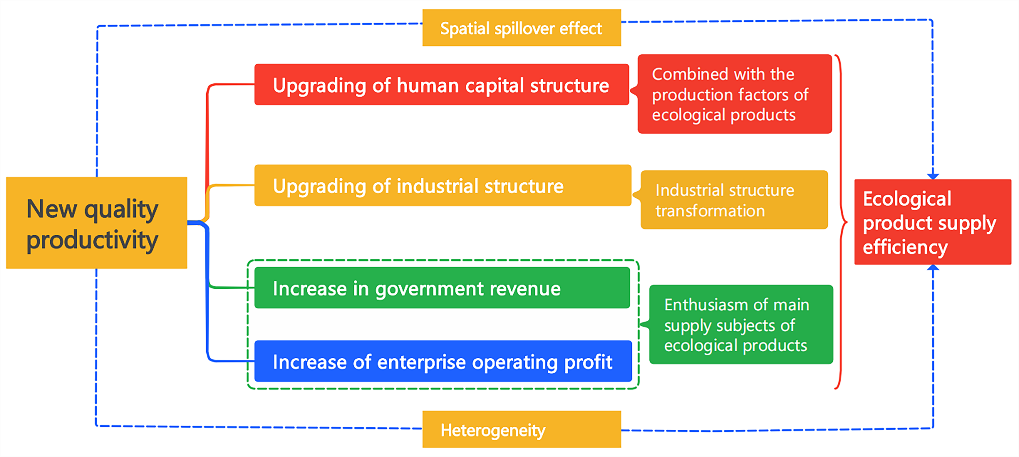
Ecological product supply efficiency (SEEP) is critical to regional ecological quality and sustainable development, yet how new quality productivity (NQP) shapes this process remains underexplored. Using panel data from 30 provincial-level regions in China over 2011–2022, this study evaluates NQP development and SEEP through entropy-weighted TOPSIS and the super-SBM model, then applies a spatial econometric framework to examine their relationship. The results show that NQP significantly improves SEEP, and this effect extends beyond local boundaries, as regions with stronger NQP development also tend to lift supply efficiency in neighboring areas. Further analysis reveals that NQP works through several interconnected channels. It reshapes the workforce toward higher-skilled labor and pushes industries toward greener and more sophisticated structures, reducing pollution pressure while enriching ecological product supply. It also expands local government fiscal capacity, enabling greater investment in ecological protection, and raises enterprise profitability, motivating firms to participate more actively in ecological product supply. The strength of these effects varies by region, with the western region tending to gain more from NQP advancement than the more mature eastern region. These findings offer practical guidance for China and other developing economies seeking to improve ecological product supply through productivity-driven and regionally tailored policies.