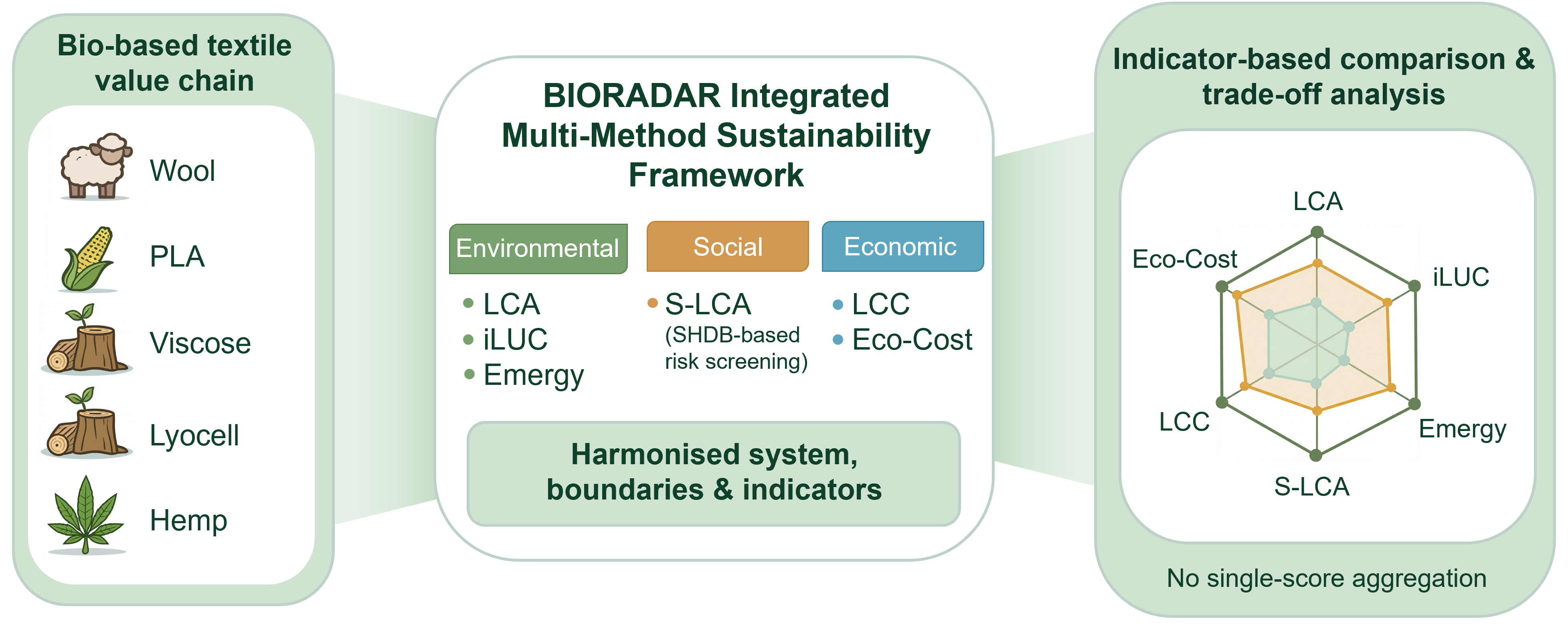
Bio-based and circular value chains require integrated sustainability assessment, yet environmental, social and economic methods are often applied in isolation. This paper presents the BIORADAR Integrated Multi-Method Sustainability Framework (BIMMSF), which links a harmonised cradle-to-gate life-cycle inventory to an indicator-based integration of Life Cycle Assessment (LCA), indirect land-use change (iLUC), Emergy evaluation, SHDB-based Social LCA (risk screening), Life Cycle Costing (LCC) and Eco-Cost. BIMMSF avoids a single composite score and instead supports cross-pillar interpretation of hotspots and trade-offs. The framework is illustrated through a proof-of-concept textile case study comparing wool, PLA, viscose, lyocell and hemp fabrics (functional unit: 1 kg). Including iLUC strongly amplifies climate relevance for land-intensive chains (e.g., wool: 52.0 kg CO₂eq kg⁻¹ direct and 182 kg CO₂eq kg⁻¹ iLUC), while Emergy highlights very high embodied ecological work for viscose. Social risk screening and economic indicators jointly identify wool as the most critical configuration and hemp as the best-performing option within the analysed set. The proposed framework helps reduce the risk of burden shifting by making cross-dimensional sustainability drivers explicit.