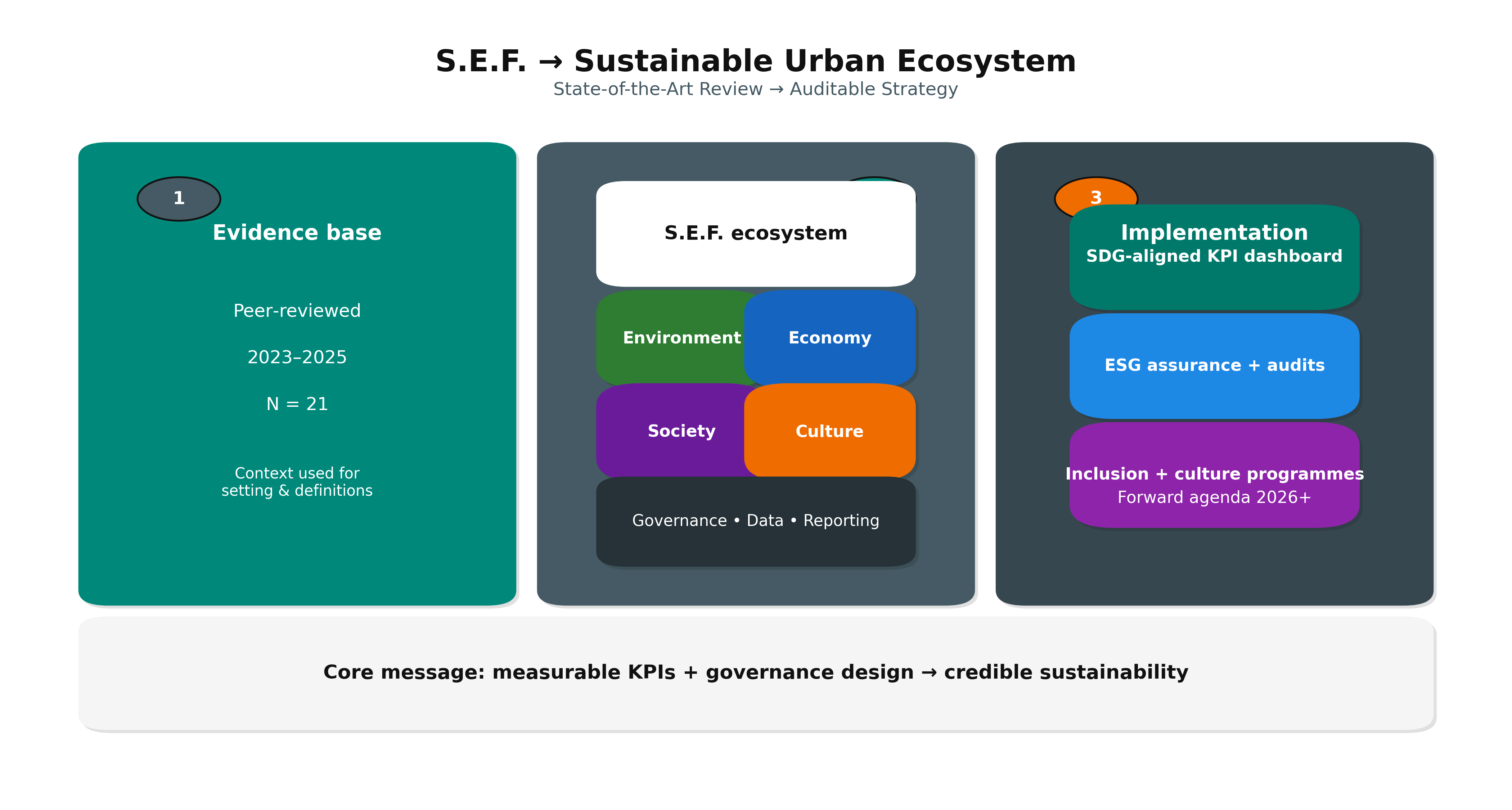
Large public sport venues are increasingly expected to operate as multifunctional urban infrastructures that deliver environmental performance, economic resilience, social inclusion, and cultural value. The Peace and Friendship Stadium (S.E.F.) in Piraeus, Greece, provides a timely case for examining how long-term governance arrangements can unlock deep sustainability retrofits and new models of public value creation. This state-of-the-art review synthesizes recent peer reviewed research and selected policy frameworks with an emphasis on the acceleration of four interlinked agendas after 2022: low carbon and energy positive operations, circular resource and waste management, social accessibility and health-oriented community programming, and the cultural reframing of stadia as heritage and learning ecosystems. Across these agendas, the literature converges on the importance of measurable Environmental, Social, and Governance (ESG) indicators, digital monitoring infrastructures, and transparent reporting as conditions for both accountability and sustainable finance. At the same time, current evidence highlights persistent tensions such as the tradeoffs between embodied and operational carbon, the risk of sustainability claims that outpace verified performance, and the possibility that green investments may increase inequalities if pricing and access are not designed inclusively. Building on the evidence reviewed, the paper proposes an integrated Sustainable Development Goals (SDGs) aligned Key Performance Indicator (KPI) dashboard for S.E.F. and outlines a forward research and implementation agenda for European public private sport venue partnerships. The review concludes that S.E.F. can function as a living laboratory for sustainable venue management, provided that governance, data integrity, and stakeholder participation are treated as core design variables rather than add ons.