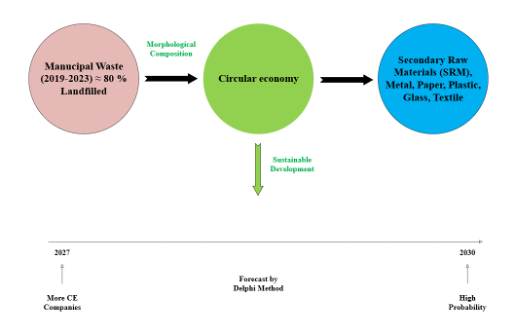
Environmental protection and resource preservation are key priorities for modern societies, and the European Union’s Circular Economy Package sets ambitious 2030 targets. As an EU candidate, Serbia faces significant challenges in aligning its waste-management system with these requirements and in increasing the use of waste as secondary raw materials. Serbia generated 3.1 Mt of municipal waste in 2023, of which nearly 80% was landfilled, with over 60% consisting of biodegradable and mixed fractions. Analysis identified five priority streams—biodegradable waste, paper/cardboard, plastics, metals, and textiles/wood—that represent the most significant secondary-raw-material potential and support the transition. However, recycled secondary raw materials remain limited, with metals dominating recovery and plastics declining in 2023 due to the market. A Delphi study with 7 experts forecast wider CE adoption in 3.6 years, with the highest probability in 2030 (P = 0.998). Results show that Serbia remains in an early CE phase, and transition priorities should be strengthening separate collection, improving the quality of secondary raw materials, and focusing on the five priority waste streams.