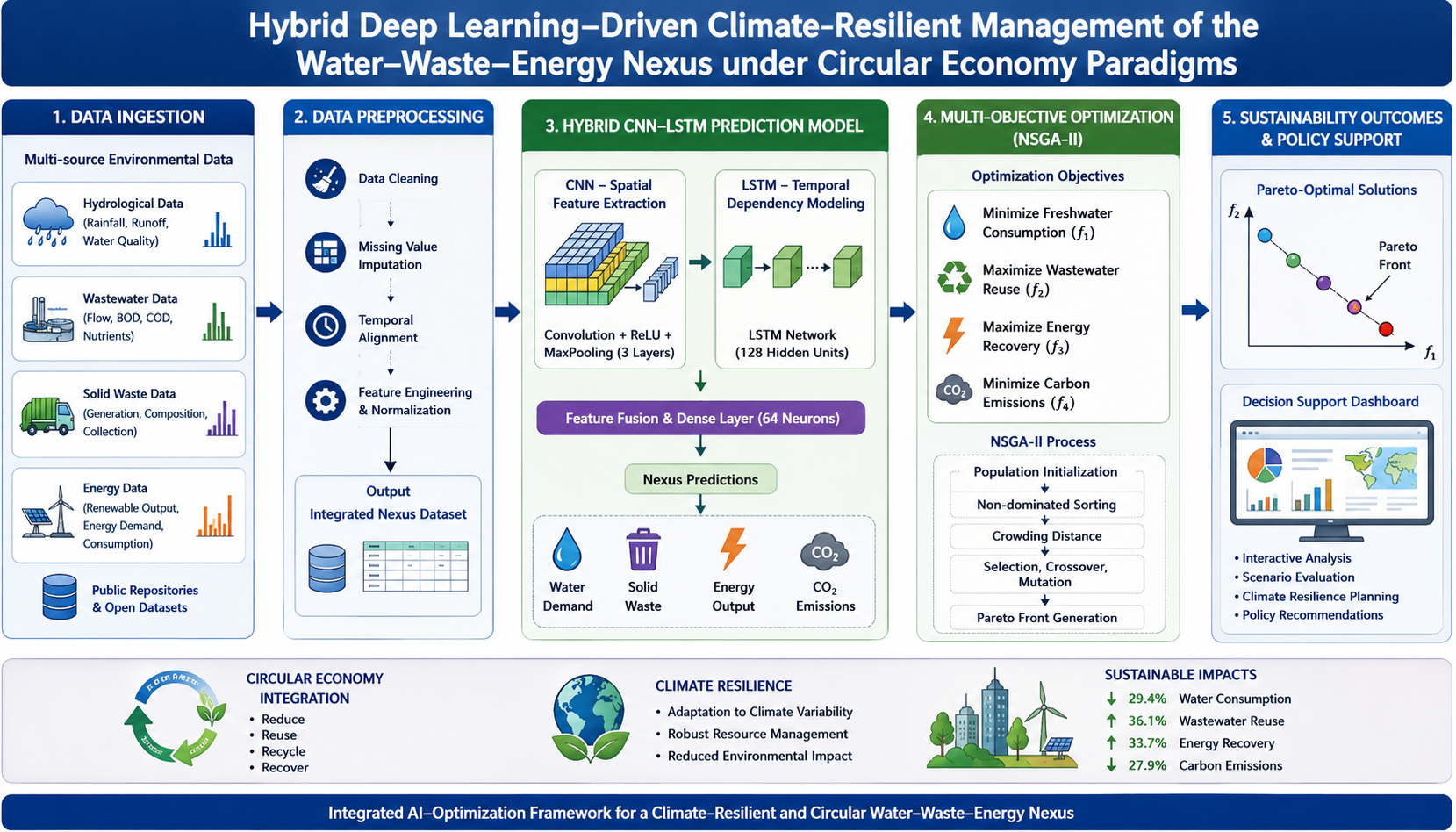
The water–waste–energy nexus plays a critical role in sustainable urban resource management under circular economy and climate resilience objectives. However, existing prediction and optimization models often lack integrated intelligence and practical decision support capability. This study proposes a novel explainable hybrid deep learning and multi-objective optimization framework for sustainable nexus management. The framework integrates CNN–LSTM for temporal-spatial prediction and NSGA-II for simultaneous optimization of water efficiency, waste reduction, and energy utilization. Publicly available multi-source datasets were integrated and validated through a structured preprocessing and synthetic data fusion protocol. Experimental results demonstrate superior predictive performance with lower RMSE and MAE compared with benchmark models, while optimization results show improved sustainability trade-offs. The proposed framework offers a practical decision-support tool for climate-resilient and circular resource planning. Furthermore, it allows energy recovery from waste to be ramped up by 33.7% with a reduction in carbon emissions by 27.9% even under climate stress scenarios. Sensitivity and robustness analyses confirm stable performance under uncertainty levels up to 25%, while explainability assessment highlights precipitation variability and waste-to-energy conversion efficiency as dominant nexus drivers.