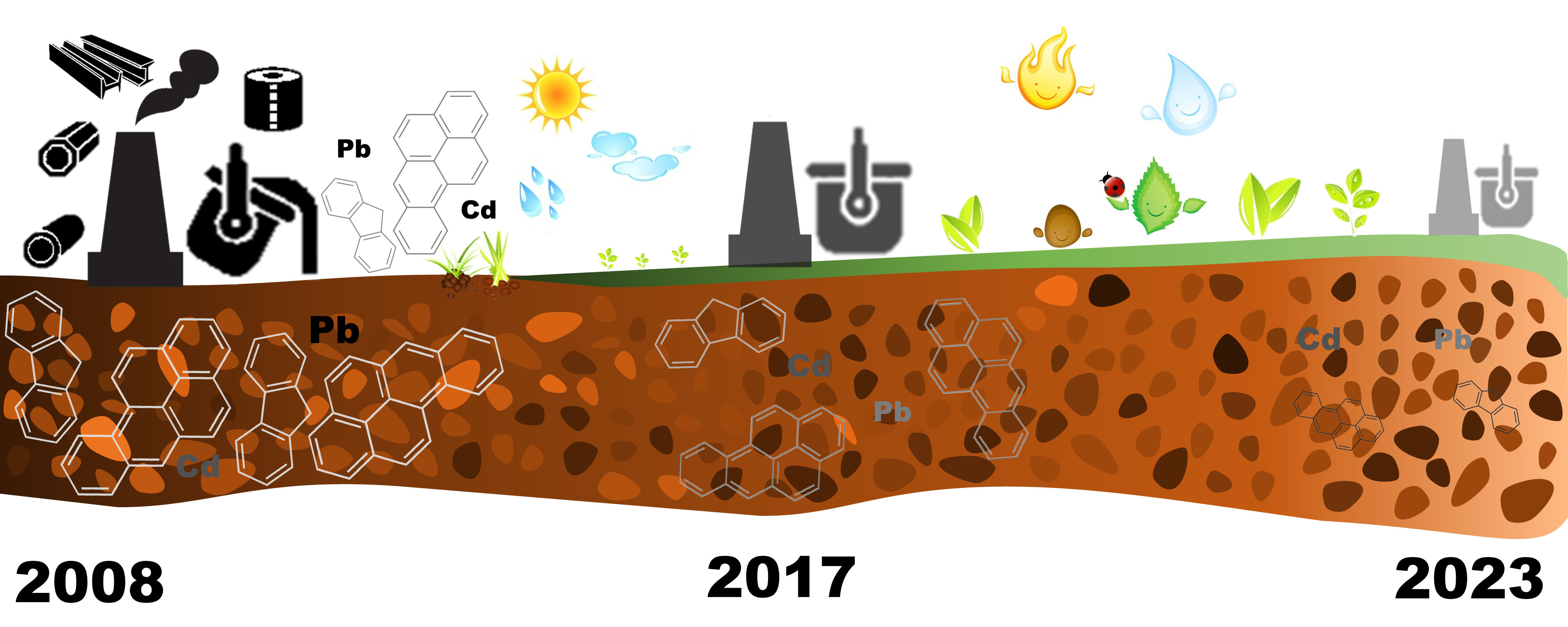
This article assesses the natural attenuation (NA) capacity of contaminated soil originating from the former Kremikovtsi metallurgical plant near Sofia, Bulgaria. Three soil sampling campaigns were conducted in 2008, 2017, and 2023 to investigate the long-term self-purification process in a “natural experiment” setting, as no remediation activities took place in the region.
Contamination levels were monitored for four heavy metals (HMs): Cd, Cu, Pb, and Zn, and seven polycyclic aromatic hydrocarbons (PAHs): acenaphthene, anthracene, benzo[a]pyrene, chrysene, fluorene, phenanthrene, and pyrene. HM content was determined using a modified sequential extraction protocol (BCR) combined with atomic absorption spectrometry (FAAS/ETAAS), while PAH content was measured by gas chromatography with flame ionization detection (GC-FID).
A robust statistical approach was implemented, where significant factor loadings in Principal Component Analysis (PCA) were determined based on p-values (p < 0.05) to ensure objective interpretation. These results were complemented by hierarchical and K-means clustering to track the spatial and temporal dynamics of the pollutants. The results demonstrate a clear trend of self-purification over 15 years, confirming the soil’s significant NA capacity. The study identifies phytoextraction and natural degradation as primary drivers of this trend, providing critical evidence that spontaneous ecosystem recovery can effectively mitigate industrial contamination in the bioactive soil layer after the cessation of anthropogenic pressure.