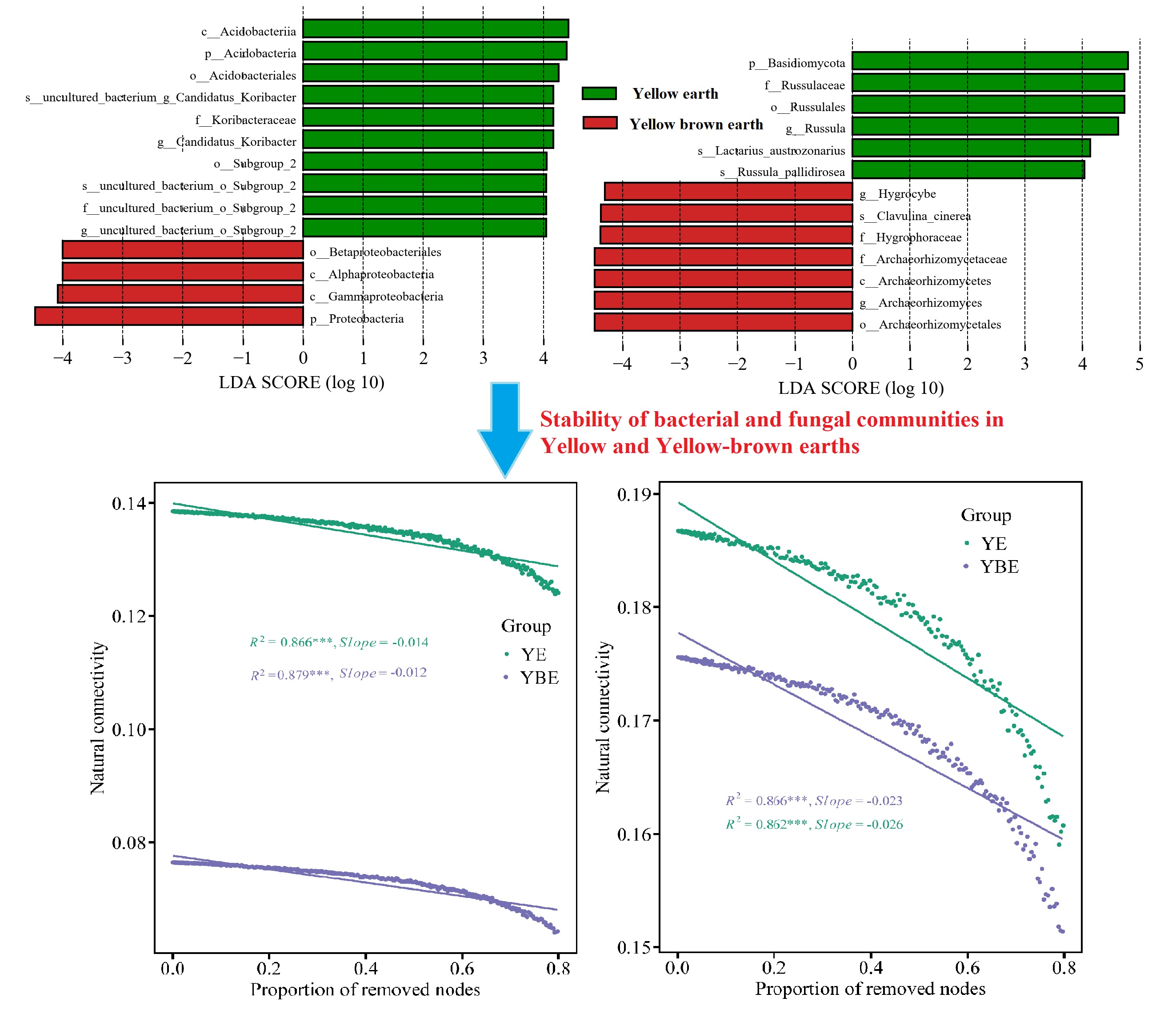
Although several studies have enhanced the understanding to Fanjing Mountain (Guizhou province, southwest China) from soil physiochemical parameters, stoichiometric, and endangered plants, however, there are rarely investigated to the differences in microbial communities in Fanjing Mountain. Therefore, this study mainly exhibits the difference of microbial community in the two typical soils (yellow earth and yellow-brown earth) in Fanjing Mountain as well as involves physicochemical parameters, microbial network structure and functional gene. Except for available phosphorus, cobalt and potassium, there are no significant differences between most physicochemical parameters in yellow earth and yellow-brown earth. Linear discriminant analysis effect size confirms that there are the significant differences at various levels of bacterial and fungal communities in the two typical soils, with 14 and 13 differential indicator species, respectively. Community similarity, mantel and redundancy analysis also demonstrates that pH is an important factor affecting bacterial and fungus communities in the two typical soils. Co-occurrence network of bacteria and fungus exhibits that the synergistic effect between microbial community is higher than the competitive effect. Functional gene expressions, including hydrocarbon_degradation, intracellular parasites, methylotrophy, methanotrophy, nitrogen_fixation, fermentation, in yellow earth are higher than of in yellow-brown earth. The proportion of symbiotoph and saprotroph dominates in the yellow earth in yellow-brown earth, respectively. Our results suggest that although there are merely the few differences between physicochemical parameters, the microbial community and functional gene vary found in the yellow earth and yellow-brown earth) in Fanjing Mountain via these discrepancies, which maybe caused by the discrepancy in pH in soil. Our study firstly emphasis the typical soil microbial community characteristics of the Fanjing Mountain forest ecosystem, providing key soil science basis for the precise protection and adaptive management of forest ecosystems in the future.