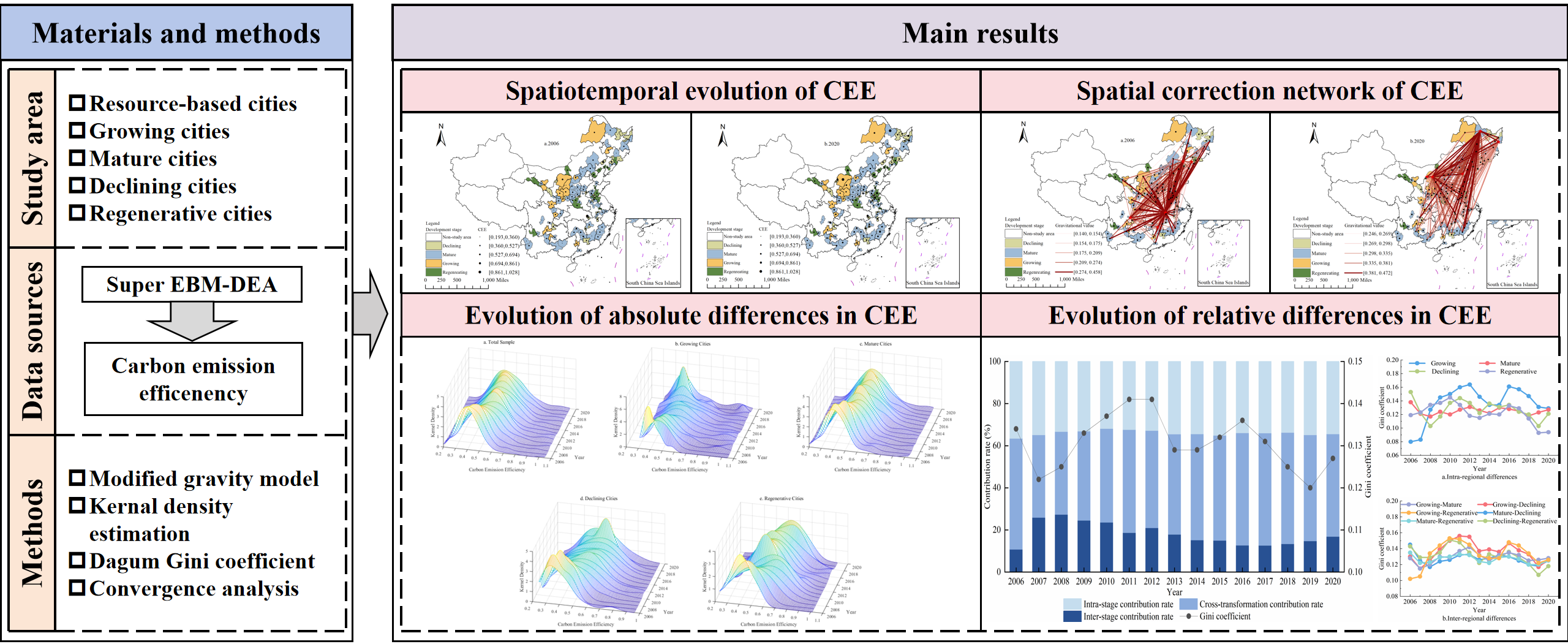
Promoting carbon emission efficiency (CEE) development in resource-based cities (RBCs) is critical for achieving China’s “carbon peak and carbon neutrality” goals. Current studies frequently cluster these cities without adequately considering their heterogeneity across developmental stages (growing, mature, declining, and regenerative). This study innovatively establishes a four-stage analytical framework, applying the super-EBM DEA model to measure CEE in 110 RBCs (2006-2020) categorized by developmental phase. Integrating a modified gravity model, kernel density estimation, Dagum Gini decomposition, and dynamic convergence analysis, the research reveals: (1) Overall, the level of CEE in RBCs has fluctuated but shown an upward trend, with a distribution pattern that follows “regenerative > growing > mature > declining” cities. (2) The spatial correlation network of CEE of RBCs is characterized by multiple nodes and threads intertwined, which feature spatially proximate correlations and inter-regional connections, with the latter being the dominant mode. (3) Regional differences in CEE among RBCs have generally decreased, although polarization within growing cities remains pronounced. Transvariation density makes the most contribution to the overall Gini coefficient. (4) CEE in RBCs at the overall level exhibits σ convergence, absolute β convergence, and conditional β convergence in space. Each of the four city types shows distinct spatial effects. Factors such as economic development levels, advancements in green technology, and industrial structures have heterogeneous impacts on CEE across RBCs. RBCs should adopt robust carbon emission reduction measures tailored to their unique conditions, facilitating the formation of a reasonably divided, highly efficient, and collaborative framework for reducing carbon emissions.