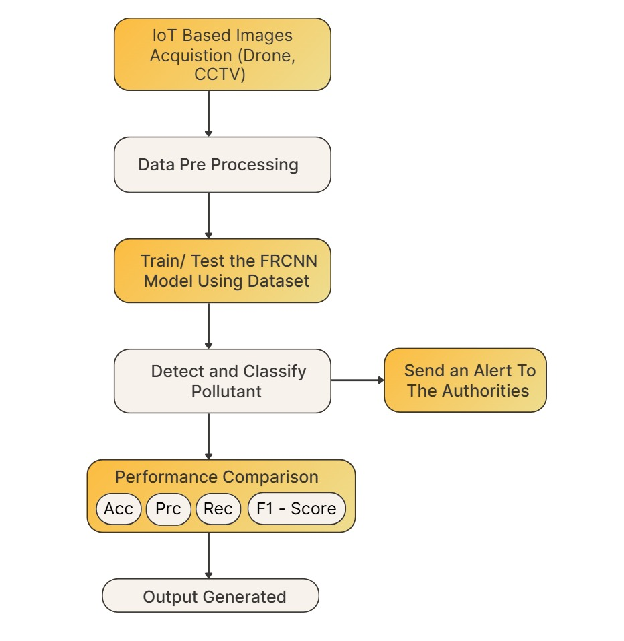
Pollution has become an increasingly critical environmental issue that immediately and severely affects human health. It increases due to the modern lifestyle, the usage of non-disposable items in daily life, increasing industrialization and urbanization, and poor waste management. Traditional pollution monitoring systems are time-consuming, labour-intensive, lack scalability, and are difficult to use for early identification using real-time surveillance. The main objective of this paper is to design and implement an automatic waste monitoring system for detecting and classifying various pollutants occurring on the river surface using a deep learning framework that can immediately alert the relevant authorized people or management to timely intervention. A custom dataset of river images was created using various sensor-based IoT devices like drones and CCTV cameras to identify and detect different pollutants, like wood, paper, plastic debris, use-and-through items, oil films, foam, and other industrial wastes. The dataset is a collection of images. Initially, preprocessing techniques, like image denoising, resizing, augmentation, and enhancement methods, are applied to improve the data quality, increasing detection and classification accuracy. This paper trains the Fast Region-based Convolutional Neural Network model using the dataset to perform object detection and classification in parallel. It is also integrated with a real-time alert system to notify the authorized people of pollutants detected in a particular region. The Fast-RCNN demonstrated high detection and classification accuracy with very few false positive rates for the test and validation datasets obtained from real-world river images. Since the proposed Fast-RCNN includes CNN, RPN, and RCNN, it can detect many kinds of pollutants in any conditions regarding light and weather, and is suitable for real-time deployment. The automated alert mechanism successfully notified authorities of precise pollutant location and type. This study presents a scalable, real-time, and automated river pollutant detection system, combining deep learning with environmental surveillance technologies. By reducing reliance on manual monitoring, the system enhances the ability of city administrators and ecological agencies to manage river pollution more effectively. Future work will focus on integrating chemical sensor data and deploying the system in large-scale smart city environments.