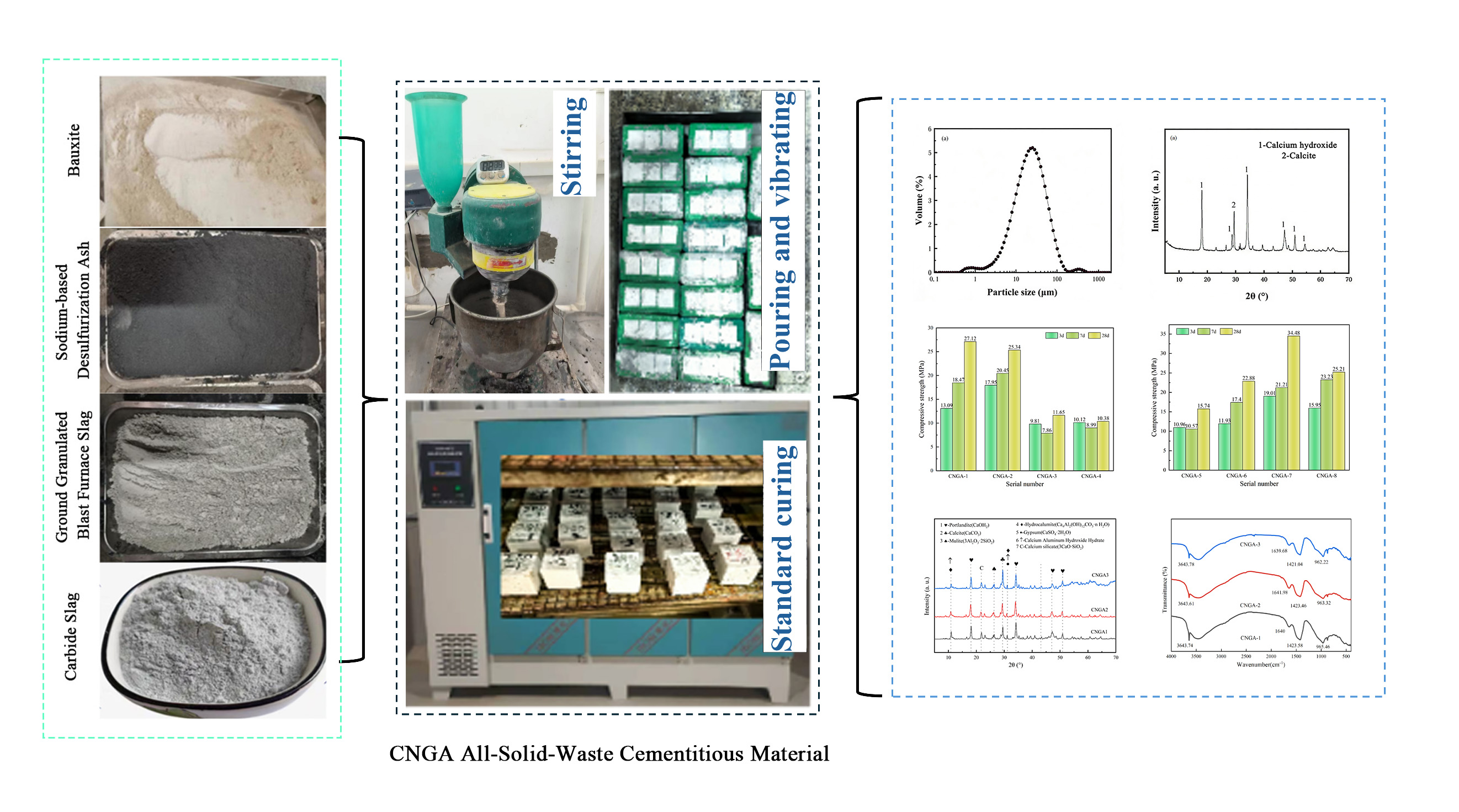
To enhance the alkalinity stability of industrial solid wastes during activation, optimize hydration products, and refine microstructure, an all-solid-waste cementitious material (CNGA) was developed in this study. Ground granulated blast furnace slag (GGBS) and bauxite (BA) were used as precursors, while carbide slag (CS) and sodium-based desulfurization ash (NDA) served as dual-alkaline solid waste activators to replace industrial strong alkalis. By systematically adjusting the mix proportion of alkaline solid wastes, NDA dosage, BA dosage, and water-to-binder ratio, the macroscopic mechanical properties were evaluated through compressive strength tests, and the hydration mechanism was investigated using XRD, FTIR, and SEM-EDS. The results indicate that CS–NDA dual-alkaline synergistic activation enables a functional division of rapid alkali elevation and long-term alkali retention, thereby ensuring continuous hydration and suppressing by-product formation. An appropriate NDA dosage significantly enhances the early-age reactivity of GGBS and BA, with an optimal content of 2% achieving a balance between alkaline activation, C–S–H gel formation, and inhibition of side reactions. Furthermore, BA incorporation supplies reactive Al₂O₃, promoting ettringite (AFt) formation and contributing to the generation of C–A–H gel. The SO₄²⁻ in NDA facilitates directional AFt formation, which enhances early-age strength and promotes the development of a gel–crystal composite microstructure.