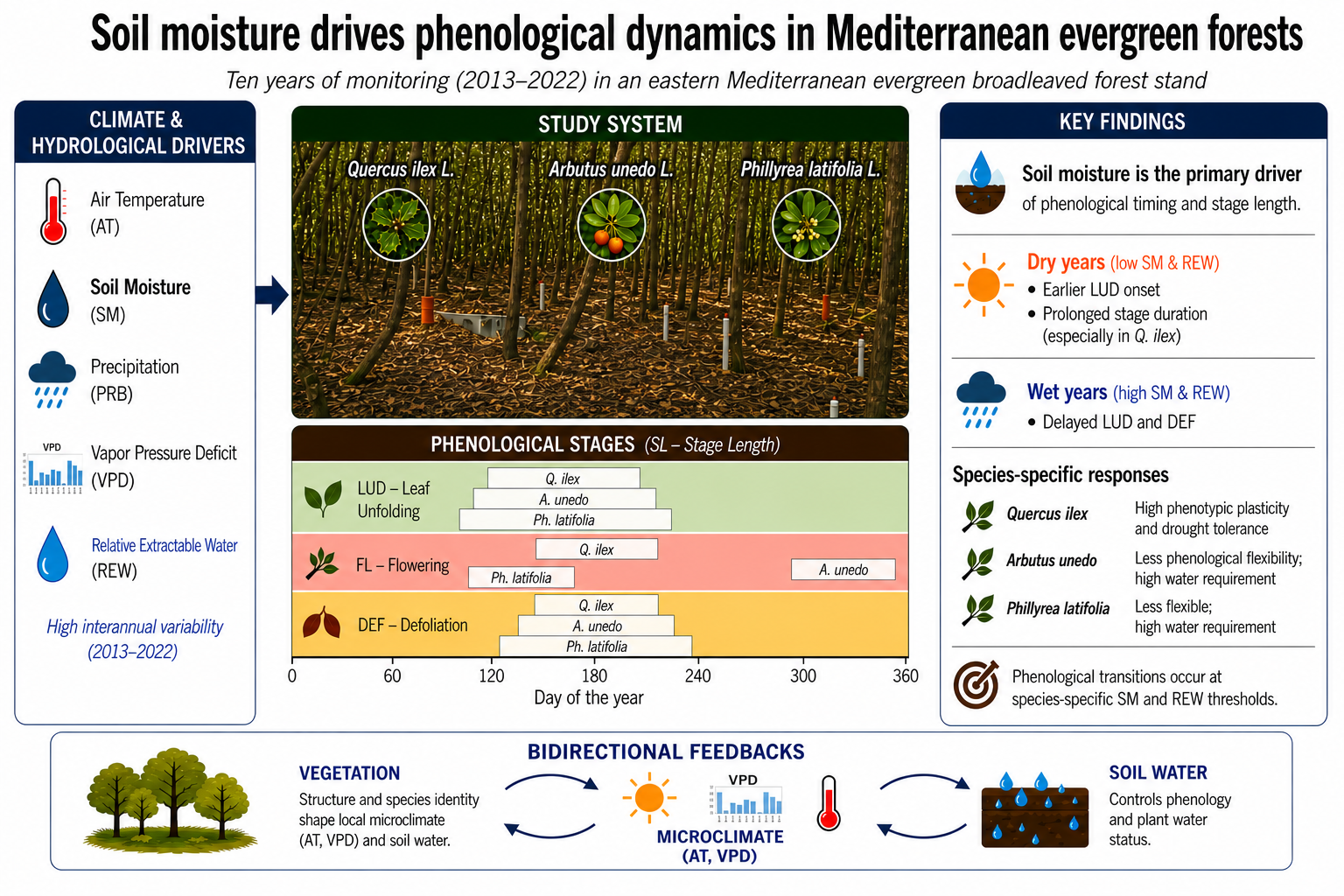
This study investigates the phenological dynamics and microclimatic influences on three dominant evergreen species (Quercus ilex, Arbutus unedo, and Phillyrea latifolia) in an eastern Mediterranean forest stand over ten years (2013–2022). Phenological stages—leaf unfolding (LUD), defoliation (DEF), and flowering (FL)—were monitored alongside key microclimatic variables including air temperature (AT), vapor pressure deficit (VPD), precipitation (PRB), soil moisture (SM) and relative extractable water (REW). Results revealed strong interannual variability in phenological timing and stage length (SL), primarily driven by soil water availability rather than temperature alone. Reduced PRB and lower SM were associated with earlier LUD onset but prolonged stage duration, particularly in Q. ilex, highlighting its greater phenotypic plasticity and drought tolerance. In contrast, A. unedo and P. latifolia exhibited more limited phenological flexibility and higher water requirements for stage initiation. DEF was also delayed under wetter conditions, while FL responses varied among species, with significant delays observed in A. unedo during exceptionally dry years. Threshold analyses indicate that critical phenological transitions occur at species-specific SM and REW levels, suggesting differentiated ecohydrological strategies. Furthermore, vegetation structure and species identity influenced local microclimate, particularly AT and VPD, demonstrating bidirectional feedback between phenology and hydrometeorology. Findings suggest that while these ecosystems currently display resilience comparable to that of western Mediterranean counterparts, increasing drought intensity may alter competitive dynamics among species. Understanding these interactions is critical for forecasting ecosystem responses to climate change and informing forest management, guiding biodiversity conservation and restoration strategies. Promoting mixed species stands that enhance soil water retention and mitigate atmospheric dryness could improve forest resilience and support biodiversity conservation under future Mediterranean climate scenarios that predict increasing aridity and temperature extremes. Integrating field phenology with soil–plant–atmosphere interactions could lead to further research focusing on the functional diversity within eastern Mediterranean evergreen species and their role in shaping local microenvironments.