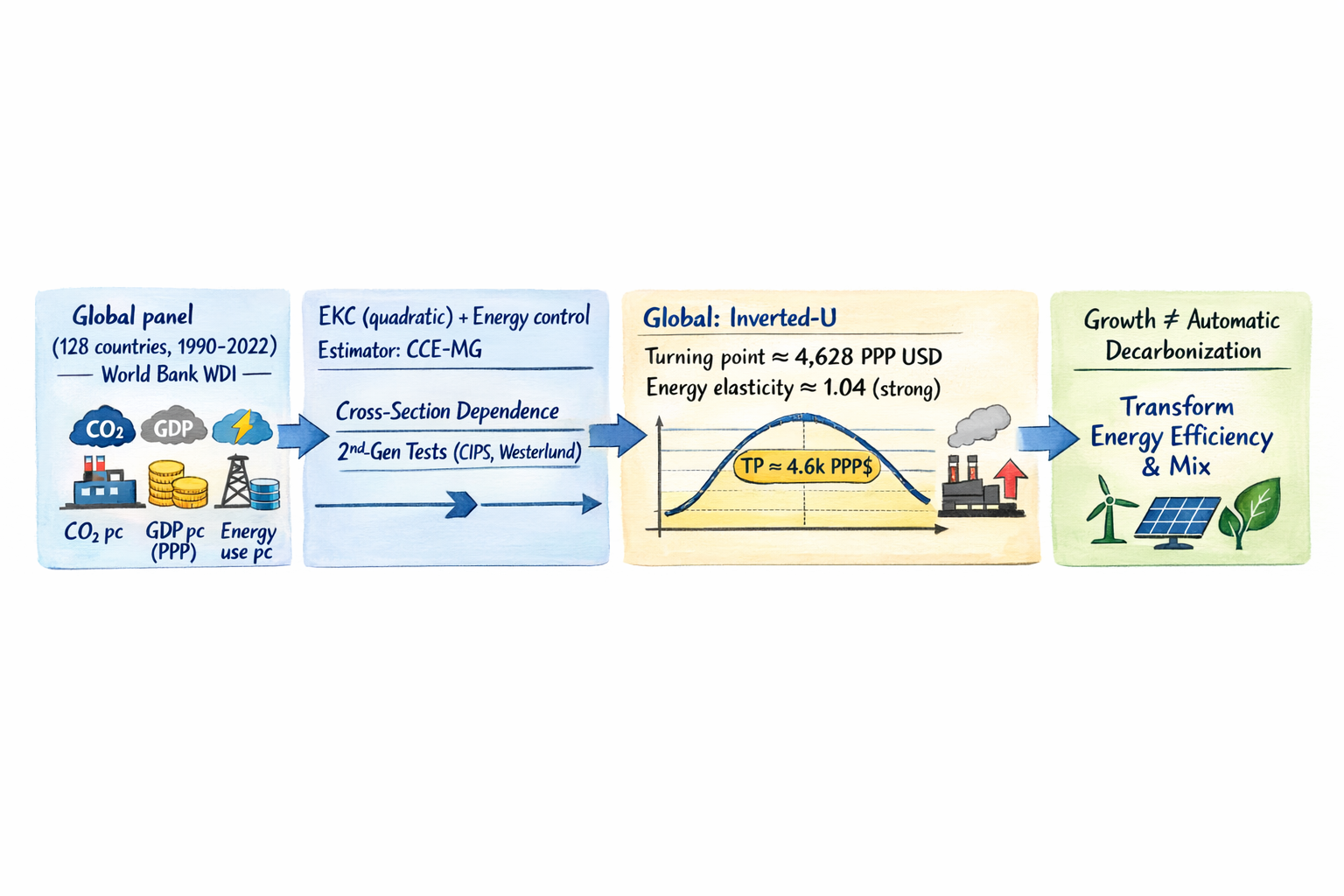
This study re-examines the Environmental Kuznets Curve (EKC) hypothesis within a rigorous methodological framework, focusing on the mediating role of energy consumption across a global panel of 128 countries (1990–2022). Utilizing second-generation econometric techniques to account for cross-sectional dependence (Pesaran CD, CIPS, Westerlund), we employ the Common Correlated Effects Mean Group (CCE–MG) estimator to address both unobserved common shocks and parameter heterogeneity. Our full-panel results provide evidence for a conditional inverted-U pattern, with an average turning point of approximately 4,628 PPP USD. However, the high elasticity of emissions relative to energy use (lnTOE \approx 1.04) indicates that decarbonization is driven more by energy intensity than by income growth alone. Furthermore, disaggregated analysis reveals that the EKC is not a monolithic reality; statistically consistent evidence is primarily confined to low-industrialization economies (IND4). These findings suggest that environmental recovery is not an automatic outcome of rising per-capita income. Instead, sustainable development requires targeted policies that prioritize energy efficiency gains and a structural transition toward cleaner energy mixes.