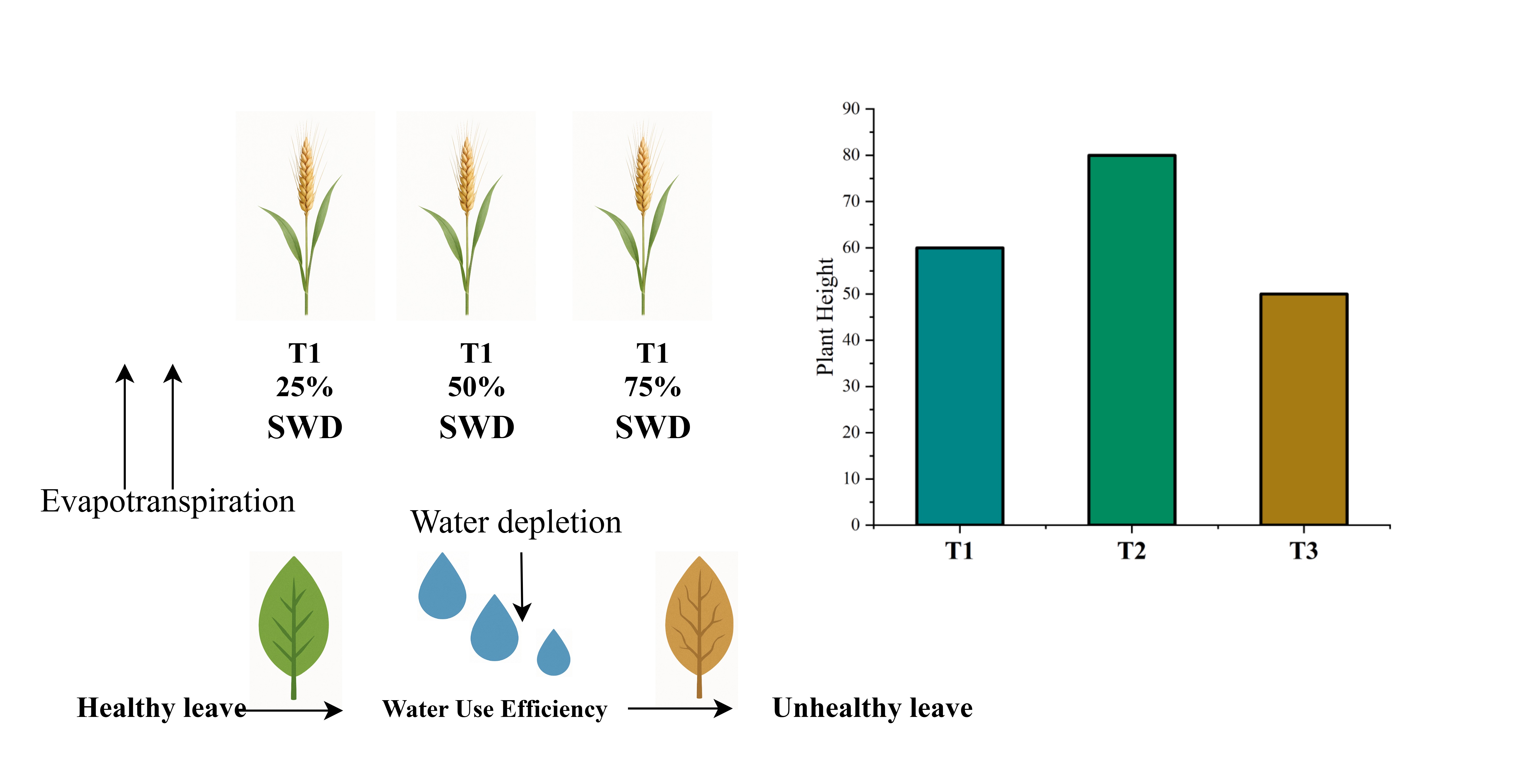
For water conservation and good agricultural management, especially in a semi-arid climate zone, it is important to accurately estimate how much water crops use. While large lysimeters are often expensive and difficult to handle, mini-lysimeters provide a cost-effective and practical alternative. The current study evaluates the performance of mini-lysimeters in determining crop evapotranspiration (ETc), water use efficiency (WUE), and establishing crop coefficients (Kc) for different wheat growth stages from November 2022 to May 2023. The experimental design contains three soil water depletion (SWD) treatments: T1; 25% SWD, T2; 50% SWD, and T3; 75% SWD, with four replicates using mini-lysimeters. The findings indicate that the daily actual evapotranspiration (ETa) of wheat ranged from 0.23 to 10.3 mm, while the seasonal ET fluctuated annually, spanning from 634 to 698 mm. However, among all soil water depletion treatments T2 has shown significant (P < 0.05) effects on wheat growth parameters, including the maximum plant height, highest spike length, numbers of tillers and the total weight of 86.8 cm, 10 cm, 137 cm, and 0.59 kg, respectively. The highest WUE was observed in T1, as it produced a relatively good yield with less water, making it the most water-efficient treatment. In contrast, T3 showed the lowest WUE due to excessive water application without proportional yield benefits. These findings suggest that a 50% SWD treatment is optimal for wheat cultivation in arid and semi-arid regions.