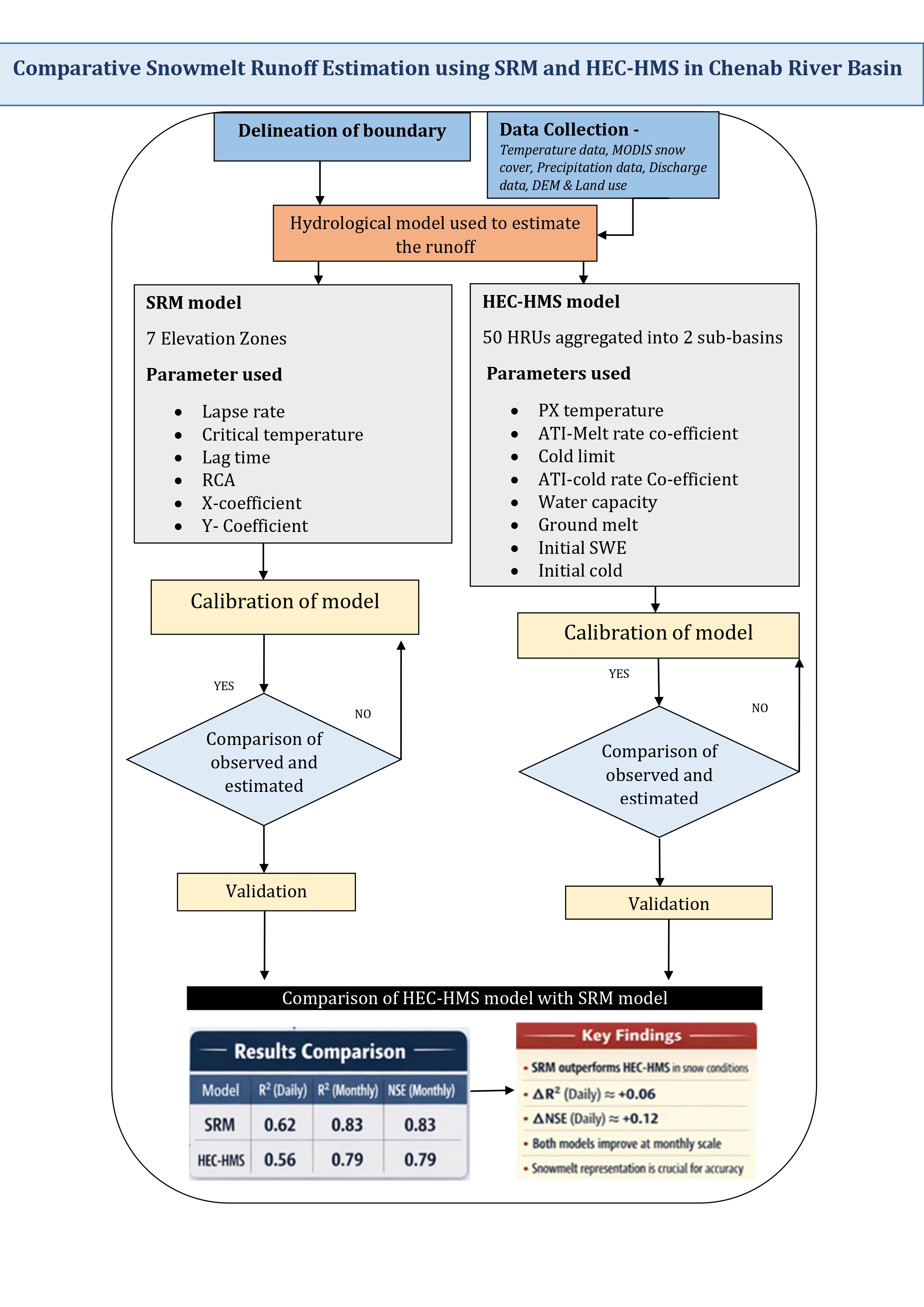
The perennial rivers that originate from high Himalayas are the major source of water during dry seasons. The flow in such rivers during dry seasons is supplied by melting of snow, the natural frozen water reserves in the high altitudes, so the estimation of runoff is very important for the planning and effective management of water. An attempt has been made in this study, to estimate the Chenab basin's daily discharge in the Himalayan region. In this study, HEC-HMS and SRM models were chosen to estimate the snow melt runoff for a period of 2005 to 2008.The calibration is done for the period 2005 to 2006 and validation is done for the period of 2007 to 2008 respectively. The simulation is done on a daily time step.. The model performance is assessed using the R² and NSE coefficient. The R² values for HEC-HMS model for daily and monthly time steps are 0.56 and 0.79 respectively. The R2 value for SRM model in daily and monthly time steps are 0.62 and 0.83 respectively. Similarly, the NSE for HEC-HMS in daily and monthly time steps are 0.69 and 0.79 respectively. The NSE value for the SRM model for daily and monthly time steps are 0.81 and 0.82 respectively. Comparison of both the SRM and HEC-HMS models shows that the daily runoff from SRM model yields higher R² value than the HEC-HMS models.