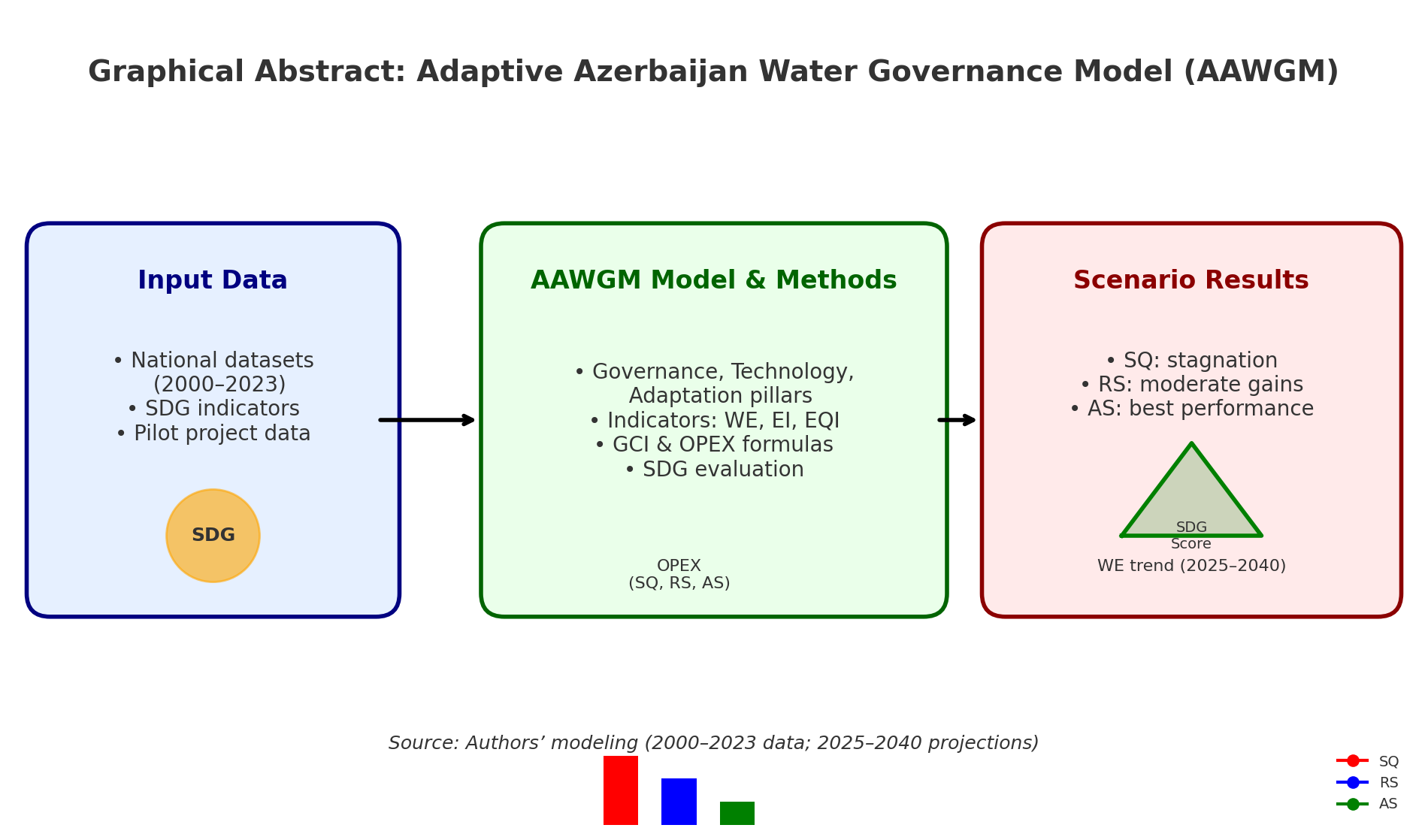
Water scarcity and inefficient resource management present critical challenges for Azerbaijan, a country heavily dependent on transboundary flows from the Kura and Araz rivers. This study develops the Adaptive Azerbaijan Water Governance Model (AAWGM), which combines the governance principles of the European Union’s Water Framework Directive (EU WFD) with Israel’s advanced water reuse and irrigation technologies. The model addresses agricultural inefficiency, outdated infrastructure, and ecosystem degradation through three integrated strategies: precision irrigation, treated wastewater reuse, and basin-scale governance reforms.
The methodological framework employs indicator-based evaluation, including the Governance Coordination Index (GCI), Operational Expenditures (OPEX), and SDG-aligned indices. All results are calibrated against national datasets for 2000-2023 and extended with scenario projections for 2025-2040, with monetary values consistently reported in USD. Findings show that adaptive and technology-driven scenarios deliver the highest performance, combining lower long-term costs with substantial gains in water efficiency, ecological quality, and institutional coordination.
Aligned with SDG 6, 7, 13, 15, and 17, the AAWGM offers a scalable roadmap for national and regional adoption. By integrating international best practices into Azerbaijan’s governance and technological landscape, the model provides a pragmatic path toward long-term water security and resilience under climate and institutional risks.