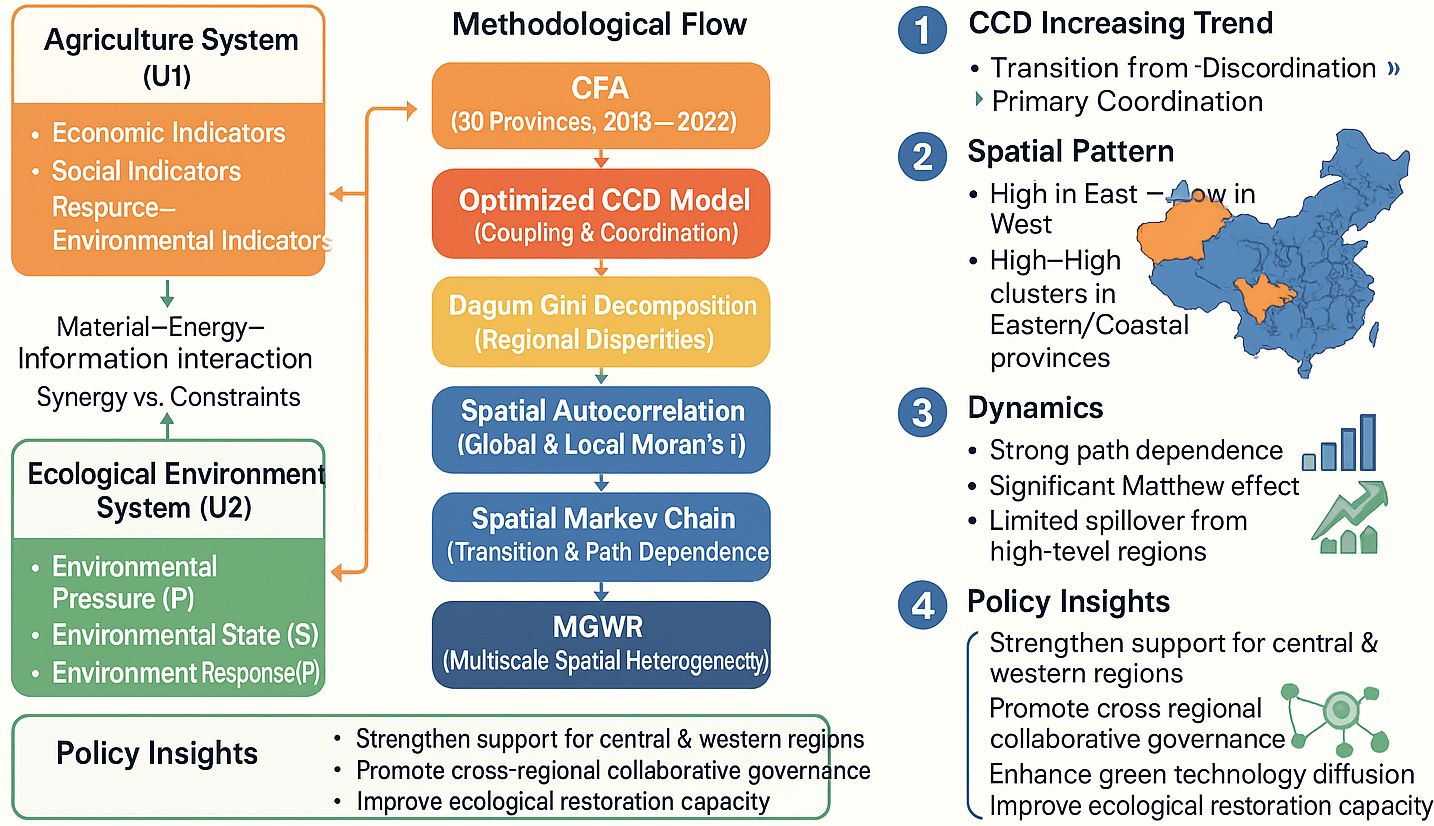
Against the backdrop of Chinese-style modernization and the national “dual-carbon” goals, clarifying the coupling and coordination relationship between agricultural development and ecological environmental protection is of great significance for safeguarding food and ecological security and advancing rural revitalization. Based on panel data from 30 Chinese provinces from 2013 to 2022, this paper constructs an evaluation index system for the two subsystems of agricultural development and the ecological environment, and employs confirmatory factor analysis to derive comprehensive development indices. On this basis, a coupling coordination degree (CCD) model is developed and optimized. The study further incorporates the Dagum Gini coefficient and its decomposition, global and local Moran’s I, kernel density estimation, spatial Markov chains, and multi-scale geographically weighted regression (MGWR) to systematically depict the spatio-temporal evolution and multi-scale spatial non-stationarity of the coupling and coordinated development between the two systems. The results indicate that the national CCD has increased overall, shifting from a state of maladjustment to a stage of primary coordination. A spatial pattern characterized by “higher in the east and lower in the west” and by “high–high” and “low–low” clusters has emerged. Regional disparities are mainly driven by an east–west divide, and path dependence as well as a pronounced “Matthew effect” are observed. The scale of the agricultural economy, the level of regional development, infrastructure, investment in ecological governance, and the quality of the ecological environment all significantly promote coupling and coordination, although their effects display marked spatial heterogeneity. Accordingly, it is necessary to implement region-specific and category-specific policies and to strengthen cross-regional collaborative governance.