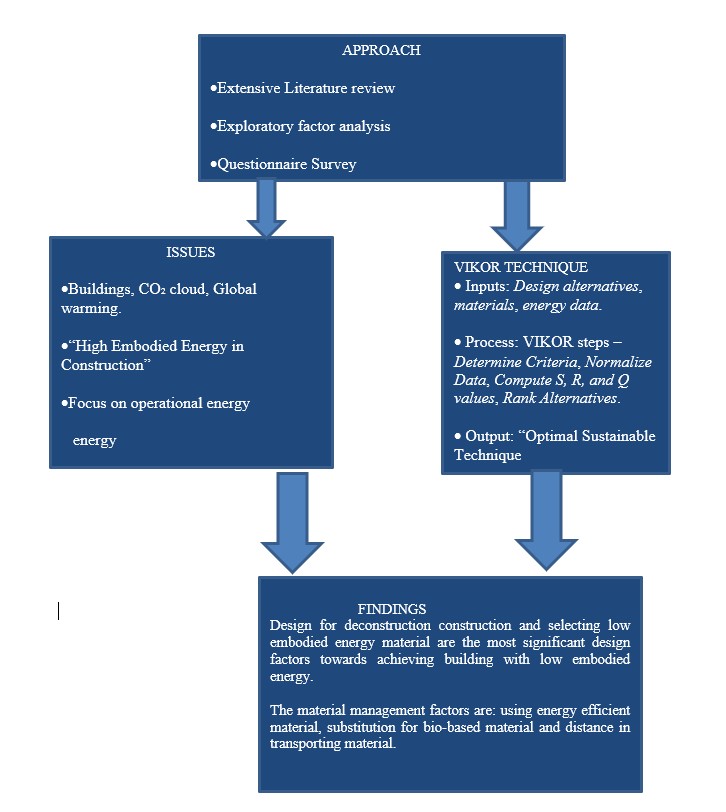
The principle of the embodied energy (EE) has drawn more recognition from various professionals within the construction industry. This is in line with the sustainable development goal (SDG), towards minimisation of environmental impacts and global warming effect caused by construction activities. However, in support of sustainable construction objectives and the reduction of embodied energy (EE) impacts, this study examines EE minimisation techniques in the Nigerian construction industry. This paradigm is important in light of the continuous efforts towards a drastic shift by professionals for less embodied energy structures. This prompts the identification of numerous EE minimisation techniques from literature from four categories consisting of design, material management, manufacturing and policy makers considerations. Subsequently, a mixed method approach consisting of 105 questionnaire survey and three (3) expert opinion survey was conducted to gather insight from the Nigerian construction processionals. A multi criteria decision technique using the provided initial weights, the VIKOR method was implemented to determine the priority ranking of the alternatives. The findings indicate that design for deconstruction and selecting low embodied energy material are the most significant design factors towards achieving building with low embodied energy. The material management factors are: using energy efficient material, substitution for bio-based material and distance in transporting material. The study contributes to sustainable construction by providing a structured framework for prioritizing EE reduction strategies in developing country contexts.