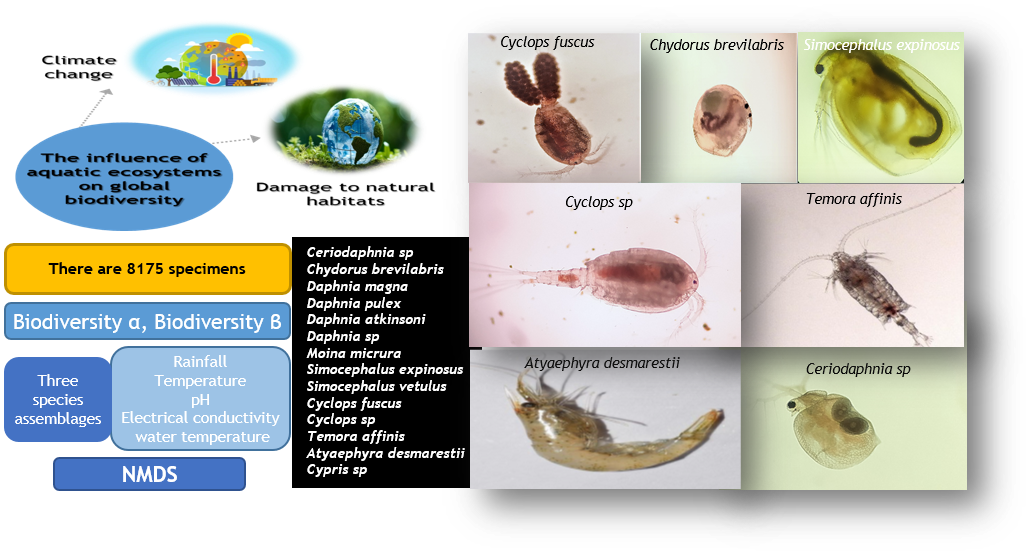
The crustacean group emerges as a keystone and performs a noteworthy role in the aquatic ecosystem as detritus eaters or included as decomposers. Understanding ecology and spatio-temporal distribution of crustaceans’ communities is crucial for the effective management of the species and the associated structural and functional services which they provide in freshwater ecosystems. This study focused on freshwater crustaceans’ communities from north-eastern Algeria, located over a distance of 337 km. The aim of this study is to provide information on the communities composition and distribution and to assess both alpha and beta diversity, as well as underlying possible factors or parameters that can be used as baseline information for further studies related to global changes. The target crustacean populations were sampled every two months during May 2022-April 2023 period from Tonga Lake (El Kala National Park), Birds Lake (El Tarf province) and El Kennar Lake (Jijel province). A total of 8,175 specimens were sampled and inventoried; 14 species were identified belonging to 9 genera: 9 Cladocerans species, 3 Copepods species, one species of Ostracods and another of Decapod. The recorded taxa match 7 families: Daphniidae, Cyclopidae, Cyprididae, Atyidae, Chydoridae, Temoridae and Moinidae. The non-metric multidimensional scaling (NMDS) ordination analysis showed a clear spatial effect in the crustacean communities and highlight three distinct species assemblages between lakes. The NMDS showed also possible effects of rainfall, temperature, pH, electrical conductivity and water temperature on communities compositions and distributions. Furthermore, the most abundant species were Cypris sp (40.36%), Cyclops fuscus (38.10%) and Simocephalus expinosus (56.19%) in Tonga Lake (S= 9), Birds Lake (S= 9) and El Kennar Lake (S= 10), respectively. The Shannon index showed similar levels of diversity with the highest value in Tonga Lake (H'= 2.48, moderate level of diversity). The Pielou evenness index also showed higher equitability in both Tonga and Birds Lakes than in El Kennar one; this latter recorded the highest species abundance (A= 3,771). According to Sorenson’s coefficient, our communities have quite a bit of overlap (from 63% to 78% of similarity). Basically, our work supports the prediction that, in Algeria, crustacean communities composition and their biodiversity could be impacted by the global changes and possibly by abiotic/biotic and physical processes. The functional diversity and the interactions with environmental factors, from global to local scales should be studied in our ongoing project concerning our local crustaceans’ communities that are still poorly documented.