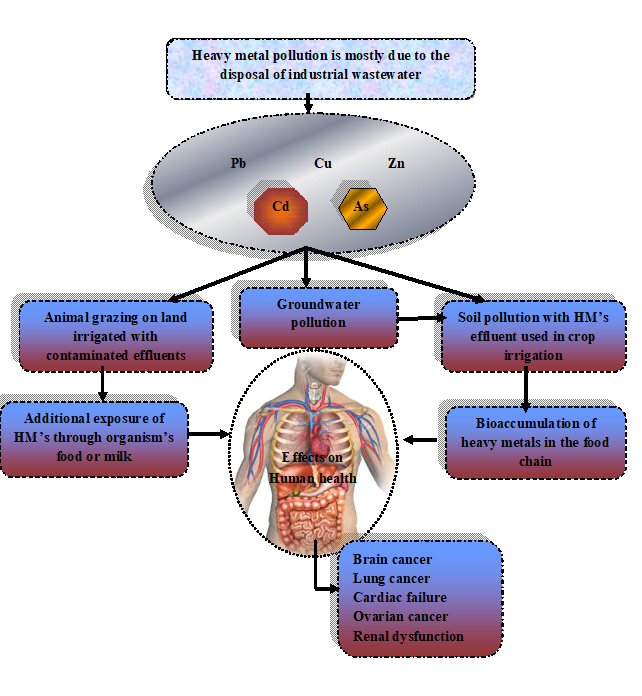
Toxicity poses a significant threat to the environment and human health. Heavy metals, such as cadmium, lead, copper, and zinc, have been shown to harm both agricultural ecosystems and human health. This paper aims to examine the effects of these heavy metals on the environment and human health, as well as discuss the problem of heavy metal deposition in soils. Additionally, the paper utilizes IoT and an SVM classifier to examine human disorders caused by heavy metal exposure. The reflectance spectra of soil samples were used to assess levels of heavy metals using an artificial intelligence algorithm. Arsenic, copper, lead, and cadmium concentrations were estimated using this method. Additionally, an artificial neural network and Naive Bayes model were developed to estimate heavy metal concentrations. The ANN model had R2 values of 0.82, 0.80, 0.76, and 0.70 for copper, cadmium, zinc, and lead, respectively, while the training data had R2 values of 0.70, 0.56, 0.62, and 0.59 for the same estimations.