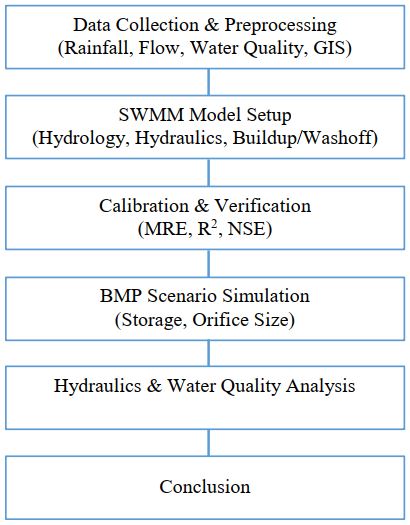
This study evaluates the hydrologic and water quality performance of a proposed retention pond located downstream of an existing stormwater structural control in the City of San Angelo, Texas. The Storm Water Management Model (SWMM) was calibrated and verified using six monitored storm events, yielding mean relative error (MRE) values of -0.23 to 0.40, correlation coefficient (R²) values of 0.80 to 0.90, and Nash–Sutcliffe Efficiency (NSE) values of 0.59 to 0.92. The verified model was applied to assess retention pond performance under varying initial storage volumes (0~100%) and three outlet orifice sizes. Results indicate peak flow reductions of 2.6~3.3%, runoff volume reductions of 0.4~40%, and pollutant load reductions of 41.4~64.3% depending on storage availability. Smaller orifices provided slightly greater peak flow attenuation under full storage conditions due to increased hydraulic retention time. Overall, the proposed retention pond can enhance flood mitigation, improve downstream water quality, and increase stormwater availability for supplemental municipal use. These findings demonstrate the value of retention-based Best Management Practices in semi-arid urban watersheds.