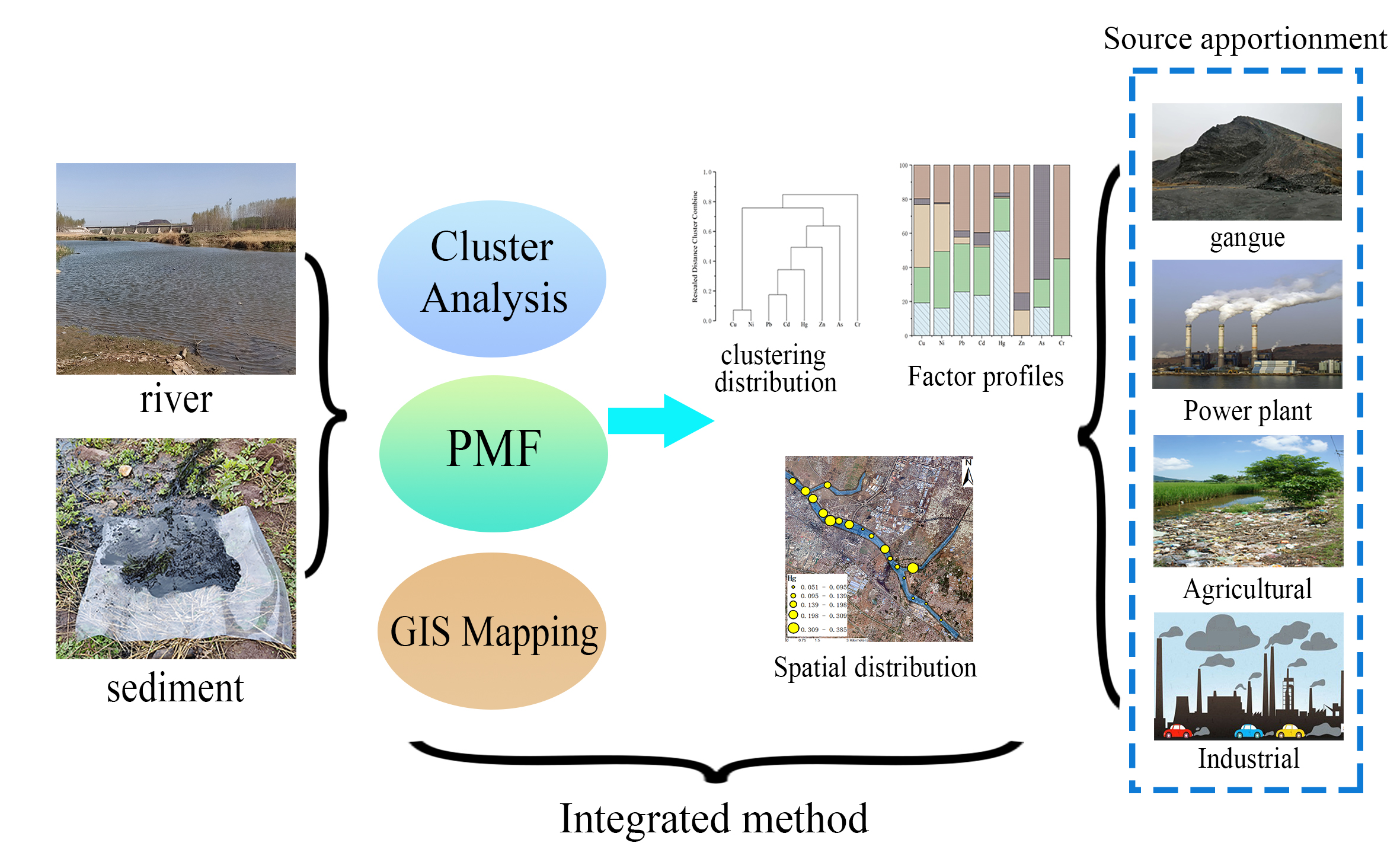
The environmental quality of rivers is a comprehensive effect of the superposition of multiple sources, and distinguishing the contribution of coal mining areas to river is an important and interesting work. In order to explore the impact of heavy metal in the sediment and to distinguish the contribution patterns of various pollution sources in the Xinwen section of the Chaiwen River in Shandong Province of China, a cluster analysis and positive definite matrix factor analysis combined method were proposed and used to analyze the heavy metal content of Cu, Pb, Zn, Cd, Cr, Ni, Hg, and As in the sediment of the main channel of the Chaiwen River, and the ecological risk analysis was subsequently conducted. The results showed that the content of 8 heavy metals in the sediment of Chaiwen River exceeded the soil background value, with Cd and Hg exceeding the standard more severely. The spatial distribution of heavy metals was closely related to the distribution of pollution sources around the Chaiwen River.The sources of heavy metals were coal mining, agricultural pollution, industrial pollution, power plant pollution, and natural sources, with their respective contribution rates of 27.40%, 22.51%, 19.09%, 7.19%, and 23.81%, respectively. According to ecological risk assessment, Cd and Hg pollution in sediments was relatively severe. The results in the case study can provide a reference for the ecological environment management of coal mining areas in the lower reaches of the Yellow River.